AI Doesn’t Do It End-to-End

It does it middle-to-middle.
We keep hearing that AI will automate the whole workflow.
“End-to-end.”
“Fully autonomous.”
“Just give it a prompt and let it run.”
But here’s what I am actually seeing:
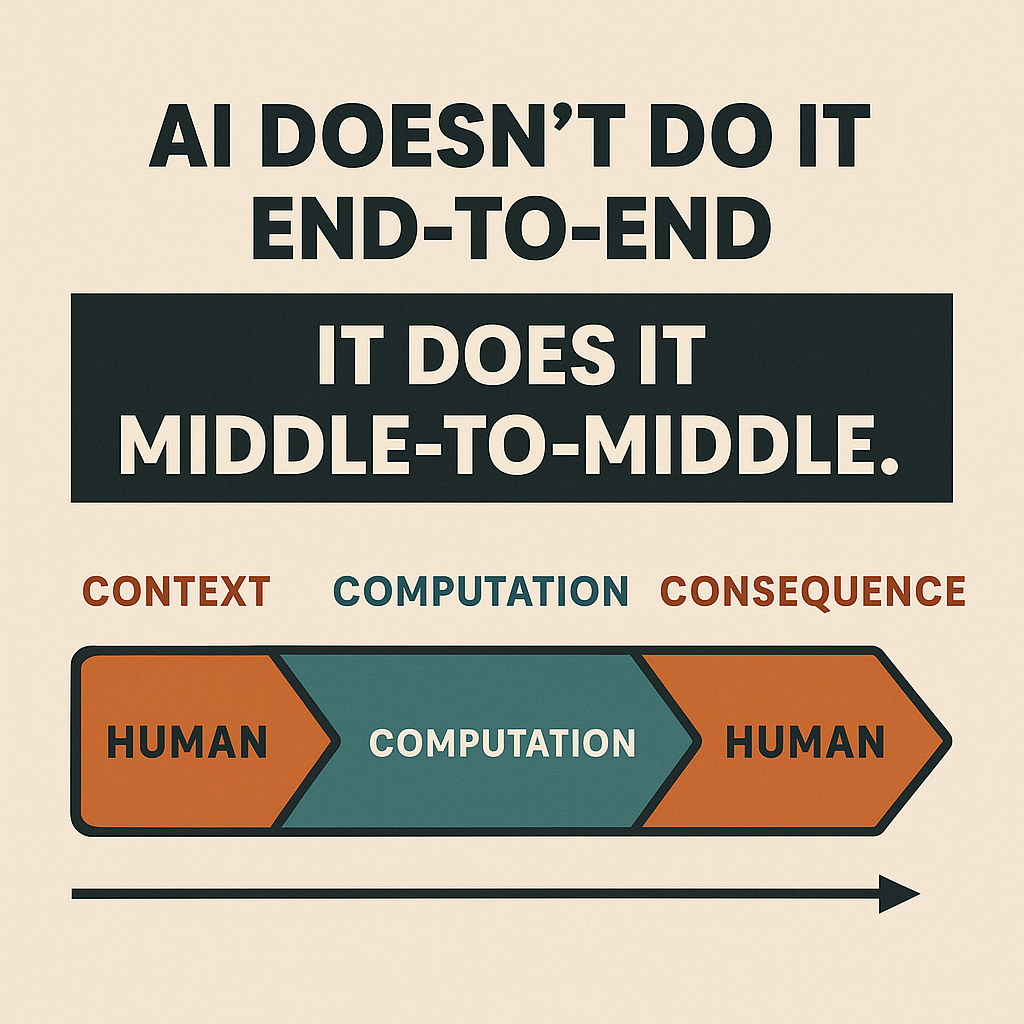
AI doesn’t do it end-to-end.
It does it middle-to-middle.
It’s brilliant once the problem is scoped.
It’s powerful before the result needs action.
But the first mile (framing the problem) and the last mile (deciding what to do with the result)?
That still lives with you.
What AI Actually Replaces
AI is extremely good at:
- Generating
- Drafting
- Suggesting
- Optimizing
- Organizing
- Repeating
- Pattern-matching
- Making confident-sounding guesses in milliseconds
But that middle zone?
That’s not where the messiest work happens.
The mess is at the margins.
- How do you frame the problem clearly?
- Who decides which tradeoff matters more?
- How do you know when a result is off—even when it looks right?
AI does the heavy lifting, yes.
But only once the humans have loaded the bar.
The New Bottlenecks
We didn’t eliminate work.
We relocated it.
And right now, two friction points are emerging as the new constraints:
Prompting
Not just “typing a good question.”
But:
- Understanding the business logic
- Knowing what context matters
- Framing the objective cleanly enough that the model knows what to ignore
Verifying
Not just “skimming the output.”
But:
- Catching subtle hallucinations
- Noticing when the logic doesn’t actually follow
- Spotting edge cases the model didn’t see
- Making sure the output is safe to act on—not just technically correct, but practically useful
These are the new pressure zones.
And they’re showing up at scale across every function.
What Changes Because of This?
Organizations are starting to realize:
- The best prompt engineer might be your PM who understands the system architecture
- Your legal ops lead might become the most valuable human-in-the-loop for contract review agents
- Your marketing strategist needs to know when not to trust the draft—even when it sounds perfect
The leverage still comes from AI.
But the advantage comes from humans who know how to design around it.
Because the real magic isn’t just generating a fast answer.
It’s knowing:
- Which answers matter
- Which ones to throw away
- And which ones to elevate into action
One Last Thought
AI fills in the middle.
But the edge still belongs to humans who can:
- Frame the right problem
- Spot the wrong answer
- Know when “good enough” isn’t
The future won’t be about who prompts the fastest.
It’ll be about who designs the loop—between AI output and real-world action.
It’s not just about getting answers.
It’s about building systems of decision-making where AI supports judgment—not replaces it.
That’s what’s under construction now.
More soon,
Gage Batten
Under Construction
How work is being rebuilt in real time