The Next Skill Gap: Interface Fluency

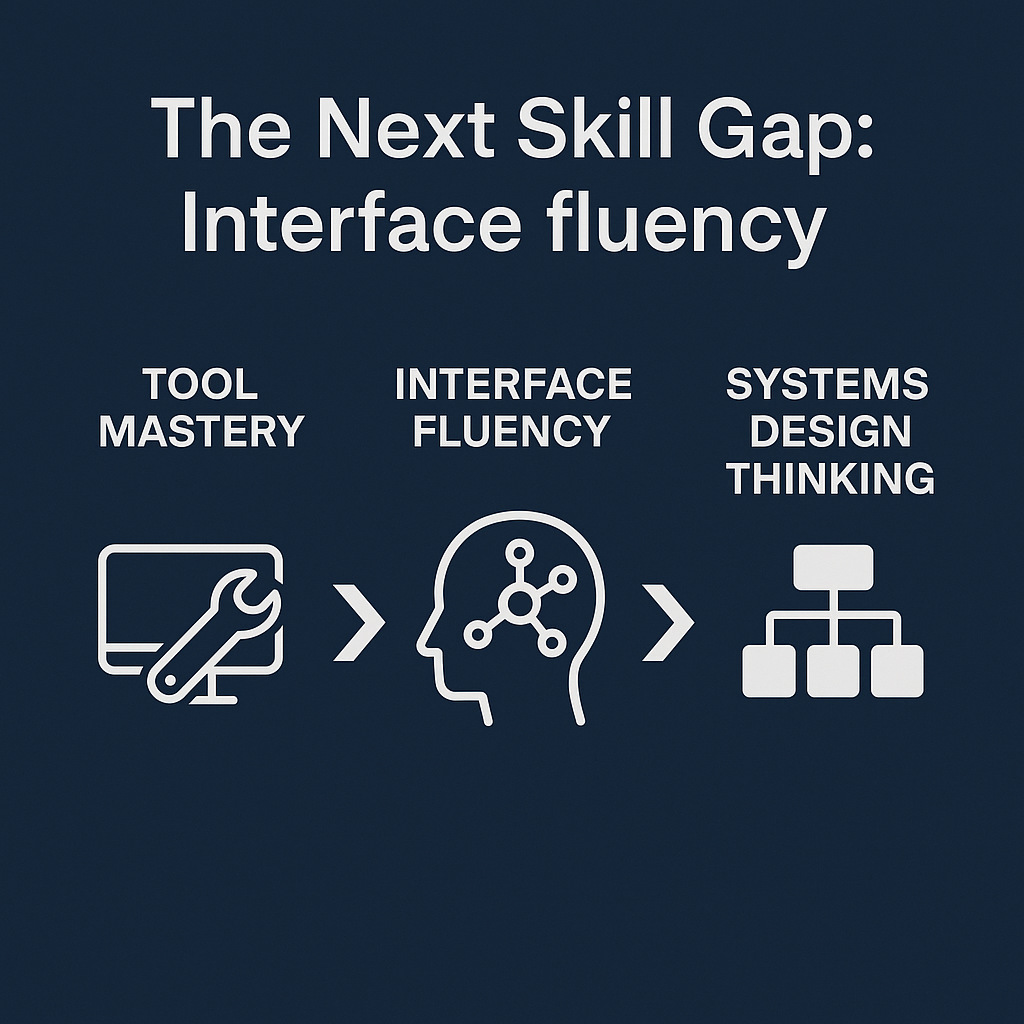
The future won’t be about using tools. It’ll be about communicating with systems that already know.
There’s a new gap forming inside organizations—quiet, invisible, and massively consequential.
We used to train for tool mastery.
Now?
The tools are smart.
But the conversation is broken.
The Real Bottleneck Isn’t Access. It’s Translation.
You can ask GPT to summarize a 30-page deck.
You can wire up agents to generate reports, file docs, respond to tickets.
Technically, it works.
But operationally?
We still don’t know:
- What to tell the system
- What the system already knows
- When the system needs supervision
- And what humans still own in the loop
This isn’t a tool problem.
It’s an interface fluency problem.
In the Future, You Won’t Be Hired to Use Tools
You’ll be hired to think through them.
The people who thrive won’t be the ones who prompt fast.
They’ll be the ones who know:
- How to scope goals with precision
- How to translate judgment into system logic
- How to design feedback loops, not just check results
- How to move ambiguity into structured execution
They won’t be “users.”
They’ll be interface architects.
What to Do Now to Prepare for Later
This isn’t about learning one tool.
It’s about building a new kind of literacy.
Here’s how you get ready:
- Narrate Your Workflows
Start writing out how you think. Show your reasoning. Frame your decisions out loud. AI will plug into your clarity—or reflect your confusion. - Design Inputs, Not Just Prompts
Stop typing like a user. Start structuring like a systems thinker. Define the inputs. Clarify the constraints. Own the objective. - Write for Transfer
Document your decisions like you won’t be in the room tomorrow. Make your thinking legible to both humans and agents. - Learn to Spot Friction Early
Notice where ambiguity slows work. Where humans stall. Where AI fails quietly. Friction is your design cue. - Think in Loops
Every task should create data for the next one. Every conversation should leave traceable context. Every outcome should feed back into the system.
One Last Thought
Interface fluency is the next literacy.
In a world where agents can do more than most people expected—
the real edge will come from those who know how to think, talk, and build through them.
Because AI won’t replace your job.
But it will change how fast your judgment is processed—or ignored.
And the people who shape how intelligence flows?
They won’t just keep up.
They’ll design what happens next.
That’s what’s under construction now.
More soon,
Gage Batten
Under Construction
How work is being rebuilt in real time