From Tech Stack to Thought Stack: How AI Will Restructure the Way Companies Think

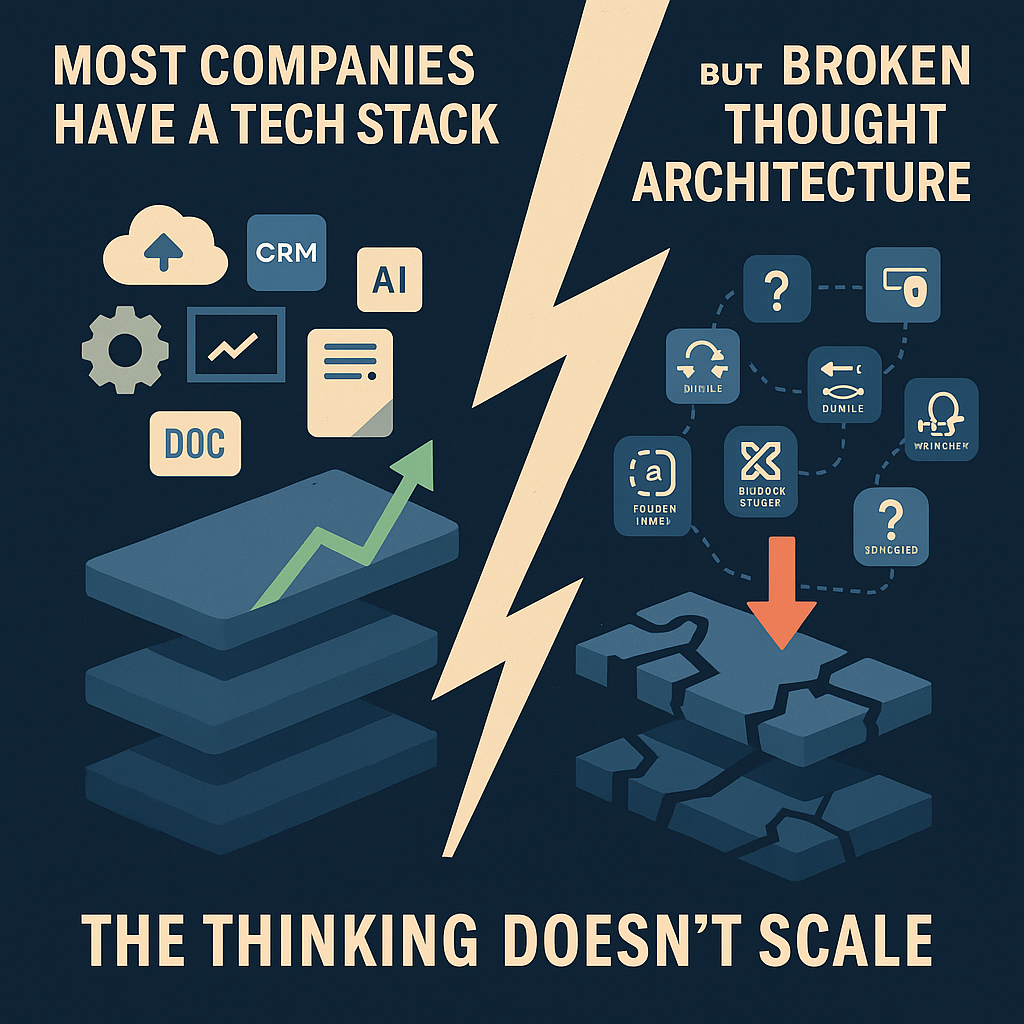
Most companies have a tech stack. CRMs. PM tools. Dashboards. Docs. Automations. AI plugins. Integrations. Alerts.
It looks like sophistication. It feels like control.
But under the surface, something's broken: the thinking doesn’t scale.
Ideas don’t compound. Context gets dropped. Reasoning gets repeated. Decisions stall or duplicate. And the system that was supposed to make everything work faster quietly introduces drag.
And now that AI is in the loop, it’s exposing all of it.
The Problem Most Companies Don’t See
The problem isn’t your tools. It’s your thought architecture.
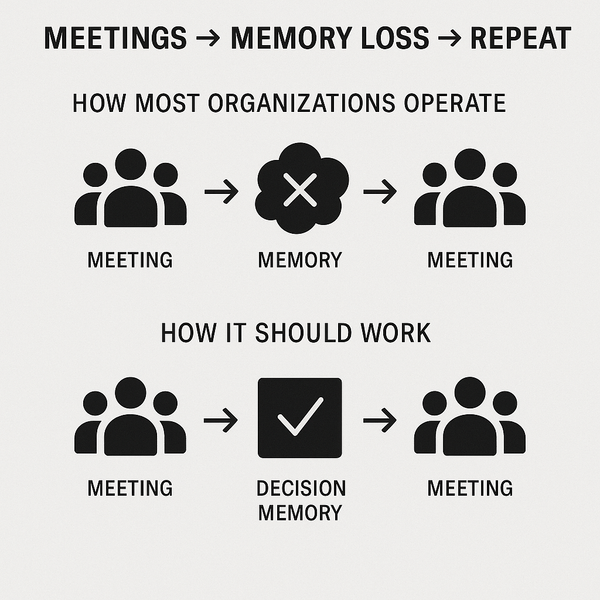
You’ve automated what happens after decisions are made—but you haven’t restructured how decisions actually get made, tracked, or remembered.
Ask yourself:
- Where does the strategic context behind your decisions live?
- How often does your team re-ask the same question in a different Slack thread?
- How many assumptions go untracked?
- How often does an AI assistant give a decent answer—and no one knows what to do with it?
Companies have modernized their execution layer. But most haven’t touched their thinking layer.
AI is about to force that rethink.
The Difference Between a Tech Stack and a Thought Stack
A tech stack moves data. A thought stack moves thinking.
In high-performing systems:
- Assumptions are logged.
- Strategic rationales are preserved.
- Decisions are traceable across teams and functions.
- Context doesn’t get lost in the churn.
- Ideas and logic evolve—they don’t restart from scratch every quarter.
A thought stack isn’t a list of apps. It’s the system your company uses to move judgment, clarity, and intent through people and time.
Without it, you get: repeated work, lost insights, and shallow outputs. With it, you get: compounding intelligence.
Why AI Breaks Legacy Thinking Systems
AI changes the surface—but it also exposes the seams:
- An assistant summarizes a doc, but no one recalls why the original plan was made.
- A bot routes a task, but the reasoning is gone.
- Context is sliced up and passed through 12 tools with zero strategic glue holding it together.
AI isn’t the problem. It’s the stress test. It reveals how disconnected your strategy, knowledge, and execution really are.
And in an AI-native company, how thinking flows becomes more important than where the files live.
What Companies Should Be Doing Right Now
This isn’t about buying another tool. It’s about upgrading your operational logic.
1. Design for Strategic Memory
- Build systems that remember why. Not just what.
- Create places for assumptions, constraints, and rationales to live.
- Treat decision trails as infrastructure.
2. Map the Invisible Workflows
- Don’t just diagram your handoffs.
- Map how people find clarity, how they escalate, how they gather signal.
- Make the thought layer legible.
3. Build Decision Objects, Not Just Outputs
- Give AI something to operate on that includes logic, not just a prompt.
- Codify playbooks and rule sets in a structured way.
- Let agents reason from your organization’s values, not just your SOPs.
4. Audit for Context Loss
- Look at every system: what happens to the reasoning once the task is done?
- Build a loop: what happened, why it happened, what should change next time.
5. Assign Ownership for Context Transfer
- Make someone accountable not just for task completion, but for context continuity.
- This is a new role: a knowledge flow operator.
The Future of Leverage Is How You Move Thinking
The companies that win this next chapter won’t be the ones with the best tech stack. They’ll be the ones with the most coherent, resilient, and scalable thought stack.
They’ll:
- Move ideas cleanly from problem to solution
- Preserve context across time and turnover
- Align humans and AI with minimal loss in translation
If you want to future-proof your org, stop asking what AI can do. Start asking how thinking moves.
More soon,
Gage Batten
Under Construction
How work is being rebuilt in real time