AI & The Future of Work – Issue #3

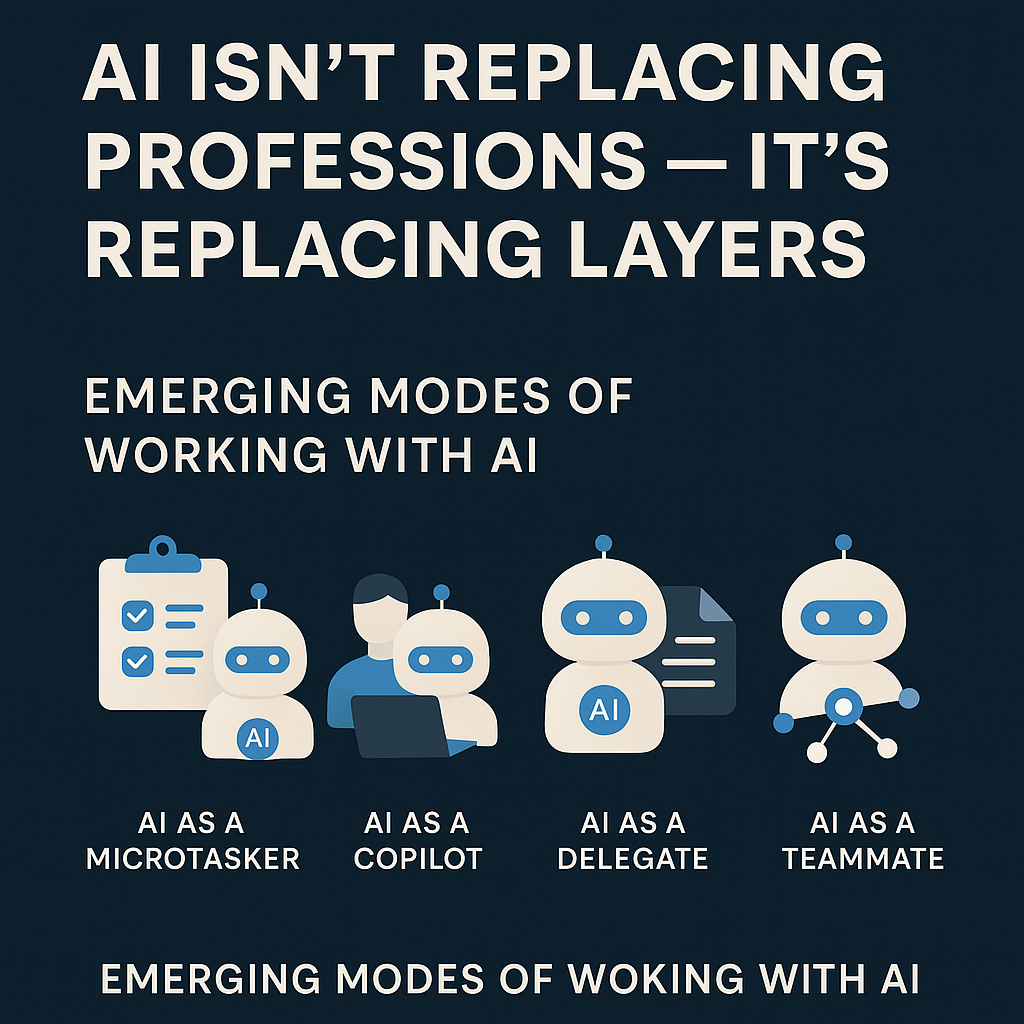
AI Isn't Replacing Professions—It's Replacing Layers
Despite all the noise, AI isn’t replacing entire professions. But it is replacing the bottom 20–80% of work in many of them—translation, design, coding, content creation, marketing, sales, operations, accounting, and even law.
This shift isn’t theoretical. It’s already happening.
The result? Small, high-performing teams like mine are outpacing corporations. Not because we have more resources—but because AI gives A-players massive leverage.
The key isn’t just using AI—it’s how we work with it.
Emerging Modes of Working with AI
Most people are still stuck at the entry-level stage of interaction—typing one-off prompts or asking for summaries. But the real leverage comes from understanding the full spectrum of AI collaboration.
Here are four key AI interaction modes—and when to use each:
1. AI as a Microtasker
Use for quick, discrete actions. Rewrite a sentence, generate a chart, fix a bug, summarize a paragraph.
High precision, low overhead.
Best for: clean, tactical outputs with minimal context needed.
2. AI as a Copilot
This is pairing mode. The AI stays with you—thinking alongside you while you work.
Live feedback while writing, coding, designing, or planning.
Human-in-the-loop collaboration.
Best for: real-time creative or technical work where you're steering.
3. AI as a Delegate
Assign a goal, walk away, and let it operate independently.
Long-form research, first drafts, structured tasks, list-building.
No human oversight until the task is done.
Best for: background tasks that take time but don’t require moment-to-moment decisions.
4. AI as a Teammate
An embedded presence across your team or company. It joins meetings, takes notes, connects dots, runs models, and even suggests strategy.
Ambient, organizational intelligence.
Best for: system-wide support, insight generation, and scalable management.
This Is the New AI Literacy
Knowing which mode to use—and when—is what separates efficient users from AI-native operators.
It's no longer about just asking ChatGPT for help. It's about integrating AI as part of your workflow architecture, not just as a tool.
Those who figure this out now will move faster, scale smarter, and outperform larger competitors.
Where are you on this curve? Reply and let me know.
As always, this newsletter is shared via email. If the interest keeps growing, I’ll roll it into a more formal format. Forward this to anyone you think should be part of the conversation.