By Reader Request: AI Wars: Who’s Actually Winning—And What Comes Next

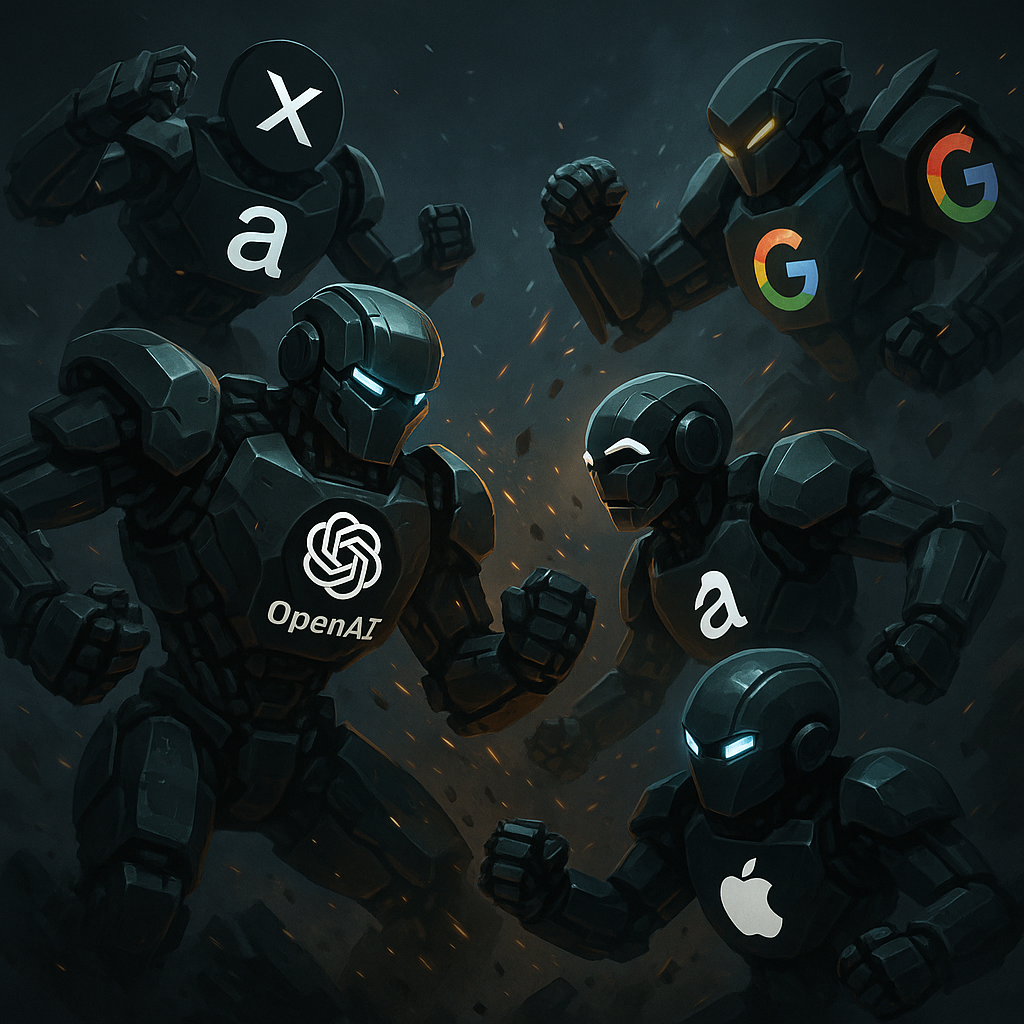
We’ve moved past the model race. The real fight is for systems—and selves.
Who’s Winning Right Now?
Let’s break it down.
Model Leadership
OpenAI leads in deployment, ecosystem, and pace. GPT-4o is still the standard for general use.
Anthropic (Claude 3.5) is catching fast, with the most trusted model for subtle reasoning and enterprise logic.
Google (Gemini) has raw capability but a fragmented product story.
Meta is enabling the open ecosystem, not owning it.
xAI is the wild card—if it gains real distribution, it changes everything.
Prediction:
OpenAI dominates short-term.
Claude becomes the enterprise default.
Google remains dangerous but disorganized.
xAI could surprise. Meta enables but doesn’t lead
Interfaces & Ecosystem
ChatGPT is still the default AI interface for the world. It has memory, tools, workflows, and organizational scale.
Perplexity is moving faster than anyone—quietly becoming a real threat to Google in AI-native search.
Microsoft is everywhere—but shallow.
Apple hasn't moved yet. But when they do, they will own the interface layer instantly.
Prediction:
ChatGPT wins the productivity layer.
Perplexity wins AI-native search.
Apple is the nuclear threat. What Happens When They Jump?
With the war chest Tim Cook sits on, the moment Apple decides to go full-stack, everything shifts.
- They already own the world’s most used interface.
- They have your voice, your face, your thumbprint, your photos, your calendar, your messages.
- They don't need to build context. They already have it.
In a world where context is leverage, Apple starts 10 moves ahead.
If they ship a local, private, persistent GPT-Me-style agent that just works—
everyone else becomes middleware.
Apple is weighing a radical shift in its AI strategy by considering Anthropic and OpenAI as potential providers for the next-gen Siri, moving away from its long-standing reliance on proprietary in-house models, Bloomberg Reports.
This comes after a series of technical setbacks within Apple’s AI division, as the company struggles to keep pace with Google Assistant and Amazon Alexa. Anthropic is reportedly asking Apple for a multibillion-dollar annual licensing fee, prompting Apple to keep OpenAI in the running for negotiating power. Siri has lagged behind in the generative AI race, and Apple’s openness to outside AI shows just how high the stakes are. With a smarter, revamped Siri not arriving until 2026, Apple is scrambling to stay in the game as the AI competition heats up further
Microsoft: The Deep Game Nobody’s Watching
Microsoft already owns the enterprise backbone.
They are the platform behind:
- Docs
- Collaboration
- Identity
- Governance
- Security
- LLM deployment itself (Azure)
They have GPT embedded everywhere—Word, Excel, Teams, PowerPoint.
But here’s what people miss:
They haven’t even gone all in yet.
So the question isn’t if they make a vertical move.
It’s when.
And when they do—likely post-OpenAI partnership unwinding or renegotiation—they’ll:
- Launch their own assistant
- Fine-tune against internal Microsoft context (e.g. enterprise-grade memory, security)
- Create true AI-first workflows inside Microsoft 365
- Bake orchestration directly into Outlook, Teams, and Edge
Prediction:
Microsoft becomes the enterprise operating system for agent work.
Think “Windows for distributed cognition.”
Agents & Orchestration
Everyone has a demo. No one has a full system.
- Devin showed what's possible.
- AutoGen, CrewAI, LangGraph are laying foundations.
- OpenAI Assistants API is the quiet monster—if unified with memory and autonomy, it wins.
- Anthropic is playing the long game: cautious, deliberate, but technically elegant.
Prediction:
The winner will solve multi-agent coordination + persistent memory.
There will be a “Stripe for orchestration.”
We haven’t seen it yet.
What to Watch Next
The model race was phase one.
The product layer was phase two.
Now we’re entering phase three:
System design. Agent orchestration. Personal operating systems.
The battle for marginal intelligence is over.
The new war is for compounding intelligence—and the systems that let it stick, scale, and think for itself.
Here’s what to keep your eye on:
- Apple’s first true move. If they launch a local, privacy-first, persistent GPT-Me-style agent, the interface war ends fast.
- Microsoft’s vertical integration. When they go all-in on their own assistant layer, they’ll instantly become the OS for enterprise cognition.
- The first “Stripe for orchestration.” Whoever solves agent memory, multi-agent coordination, and secure autonomy wins the workflow war.
- The rise of org-wide system thinking. The companies who rebuild how decisions, memory, and judgment flow—not just tools—will move from automation to actual advantage.
- The emergence of GPT-Me. Persistent, portable, personal intelligence isn’t science fiction. It’s almost here. And it changes how you think about work, data, and identity.
The next 12–18 months won’t be about who launches faster.
They’ll be about who designs deeper.
Because in the next era of AI, the winners won’t just build with it.
They’ll build for it.
That’s what’s under construction now.
More soon,
Gage Batten
Under Construction
How work is being rebuilt in real time