Comparing the Top Web-Based AI Models for 2025: A Strategic Guide for Operators

In early 2025, the AI landscape looks dramatically different than it did even a year ago. With powerful new releases from OpenAI, Anthropic, xAI, and Google, the options for integrating AI into your workflows have never been richer—or more overwhelming.
Whether you're running a team, managing operations, or handling complex technical tasks, knowing exactly which AI model suits your needs can significantly amplify productivity and decision quality.
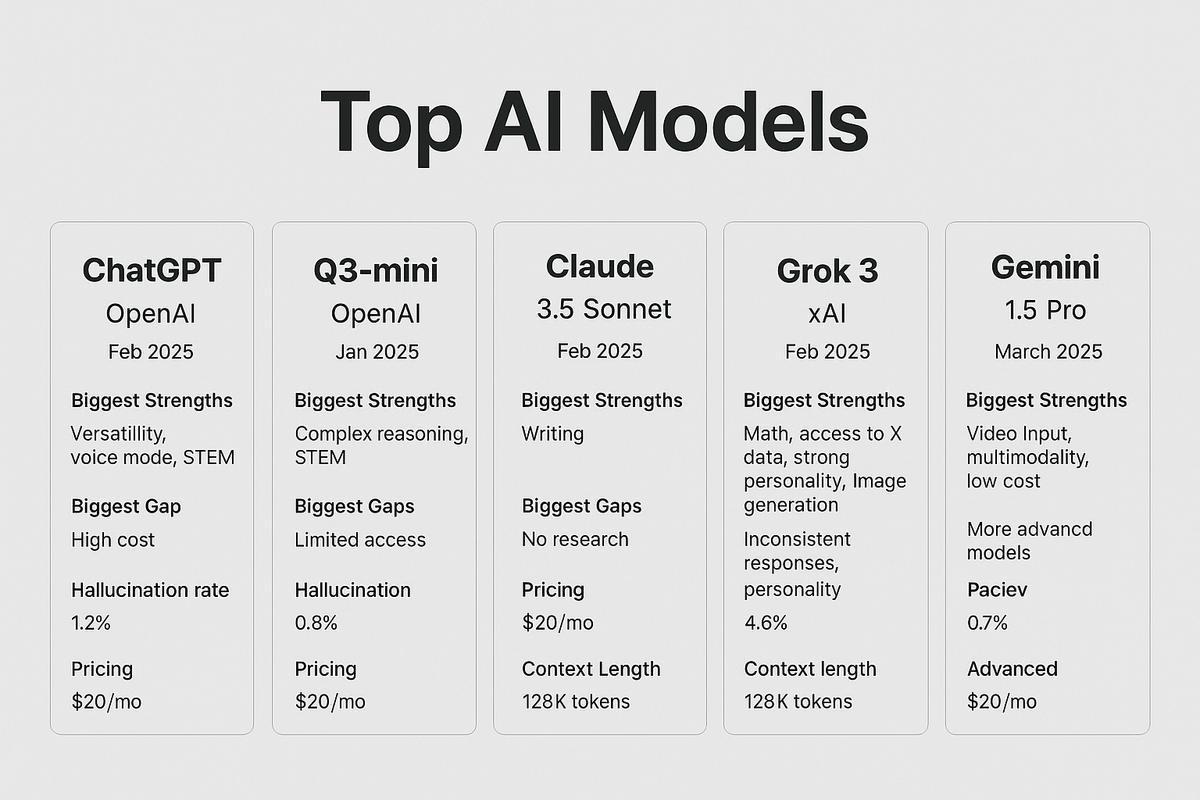
To simplify your choices, here's a concise breakdown of the latest AI models, including their strengths, weaknesses, and ideal use-cases.
1. ChatGPT GPT-4.5 / GPT-4o (OpenAI)
- Release Date: February 2025
- Biggest Strengths: Versatility across tasks, image generation, voice interactions, strong contextual memory.
- Biggest Gaps: STEM-specific tasks and high costs beyond the free tier.
- When to Use: General-purpose first drafts, brainstorming, online research, daily operational tasks, and interactive voice-based work.
- Hallucination Rate: 1.2%
- Pricing: Standard ($20/mo), Pro ($200/mo)
- Context Length: 128K tokens (~380 pages)
- Vibe: Broadly intelligent, intuitive at grasping user intent. Ideal for versatile daily use, especially when grounding responses in real-world facts matters.
Bottom Line: The go-to generalist. If you're looking for everyday versatility and broad applicability in operations, ChatGPT GPT-4o is tough to beat.
2. o3-mini high (OpenAI)
- Release Date: January 2025
- Biggest Strengths: Exceptional logical reasoning, STEM problem-solving, and mathematical computation.
- Biggest Gaps: General tasks; can run out quickly due to limited availability.
- When to Use: Technical, scientific, or mathematical problems, detailed logical reasoning, STEM-focused coding tasks.
- Hallucination Rate: 0.8%
- Pricing: Standard ($20/mo), Pro ($200/mo)
- Context Length: 128K tokens (~380 pages)
- Vibe: Structured, logical, methodical—ideal for precision and accuracy.
Bottom Line: The math-and-logic specialist. Deploy it when rigor and clarity are non-negotiable.
3. Claude 3.7 Sonnet (Anthropic)
- Release Date: February 2025
- Biggest Strengths: Superb writing and creative expression, complex coding capability with extended thinking, friendly conversational tone.
- Biggest Gaps: No live research capabilities, strictly limited to static context.
- When to Use: Creative writing, brainstorming, high-quality code generation, data visualization, and maintaining distinct voice or style in communications.
- Hallucination Rate: 4.4%
- Pricing: Pro ($20/mo, includes extended thinking)
- Context Length: 200K tokens (~600 pages)
- Vibe: Empathetic, proactive, and creative. Perfect for teams that value rich communication and robust creative problem-solving.
Bottom Line: The creative powerhouse. Best suited for scenarios demanding top-tier writing, coding elegance, or stylistic nuance.
4. Grok 3 (xAI)
- Release Date: February 2025
- Biggest Strengths: Strong mathematics capabilities, real-time access to X (formerly Twitter) data, vibrant and opinionated personality, capable image generation.
- Biggest Gaps: Occasional inconsistency, overly stylized personality that might not suit all business contexts.
- When to Use: Generating viral content, solving mathematical problems with thinking mode, producing modern, youth-oriented writing.
- Hallucination Rate: 4.6%
- Pricing: Premium ($30/mo for higher limits and more features)
- Context Length: 128K tokens (~380 pages)
- Vibe: Bold, trendy, youth-oriented. Best for modern businesses looking to engage younger audiences or leverage social media dynamics.
Bottom Line: The viral specialist. Ideal when personality, edge, and real-time social trends matter most.
5. Gemini 2.0 Flash / Gemini 2.5 Pro (Google)
- Release Date: January/March 2025
- Biggest Strengths: Video input analysis, multimodal tasks, largest context length, extremely low hallucination rates, reliable accuracy.
- Biggest Gaps: Advanced models (Gemini Pro) require access via Google's AI Studio platform.
- When to Use: Analysis of very large documents, multimedia (especially video) tasks, handling long-form content efficiently, reliable day-to-day tasks.
- Hallucination Rate: 0.7%
- Pricing: Advanced ($20/mo)
- Context Length: 2M tokens (~6,000 pages)
- Vibe: Reliable, consistent, structurally strong, ideal for complex, long-form analysis.
Bottom Line: The dependable analyst. Choose Gemini when you need reliability, consistency, and accuracy across huge datasets or multimedia projects.
How to Pick Your AI Model
Understanding the nuances between these models helps you use each where it truly shines:
- Need versatile daily assistance?
→ Go with ChatGPT GPT-4o. - Require rigorous math or science solutions?
→ Use o3-mini high. - Prioritize high-quality writing, coding, or creative content?
→ Claude 3.7 Sonnet is your pick. - Looking for edgy, modern, youth-oriented content or deep math reasoning?
→ Grok 3 has you covered. - Dealing with massive data sets, multimedia analysis, or needing lowest error rates?
→ Gemini 2.5 Pro excels here.
Why Choosing the Right AI Model Matters
Your operational efficiency, accuracy, and effectiveness depend heavily on matching tasks with the appropriate AI tool. Using the wrong model costs time, accuracy, and trust. But strategically leveraging the right one can amplify productivity exponentially.
In short, the right AI isn't just helpful—it's transformational.
The landscape of AI is rapidly evolving. As models continue to improve, stay flexible, experiment broadly, and always match your tasks to the strengths of each model. This disciplined approach can turn good teams into exceptional ones.
Looking Ahead: Where These Models Might Go Next
Today's AI landscape feels expansive, but we’re still early. Each model you see on the chart represents not just a snapshot of capability—but the opening move in a much larger game.
In the next few years, expect divergence, not convergence.
- Some models, like GPT-4o, will likely double down on broad adaptability, becoming the de facto infrastructure layer for thousands of niche tools and agents.
- Claude may push deeper into complex reasoning and emotional intelligence, positioning itself as the trusted thinking partner inside businesses.
- Grok will likely own more of the informal, viral, real-time space, capturing attention where personality matters more than precision.
- Gemini, with Google's scale behind it, will keep expanding into multimodal and cross-platform territory, trying to dominate long-form reasoning and information integration.
- o3-mini and other STEM-heavy models could quietly become the most important for fields like energy, biotech, and national defense, where precision and systematic thought matter more than conversational fluency.
The lesson for operators and decision-makers is simple:
Choosing the right model isn't just a technical decision. It’s a strategic one.
The model you integrate today could define how your workflows evolve, how your teams scale, and where your organization finds leverage—or loses it.
The future won't belong to those who just "use AI."
It will belong to those who think systemically about which intelligence they align with—and why.
More soon,
Gage Batten
Under Construction
How work is being rebuilt in real time