Meetings Aren’t the Problem. Memory Is.

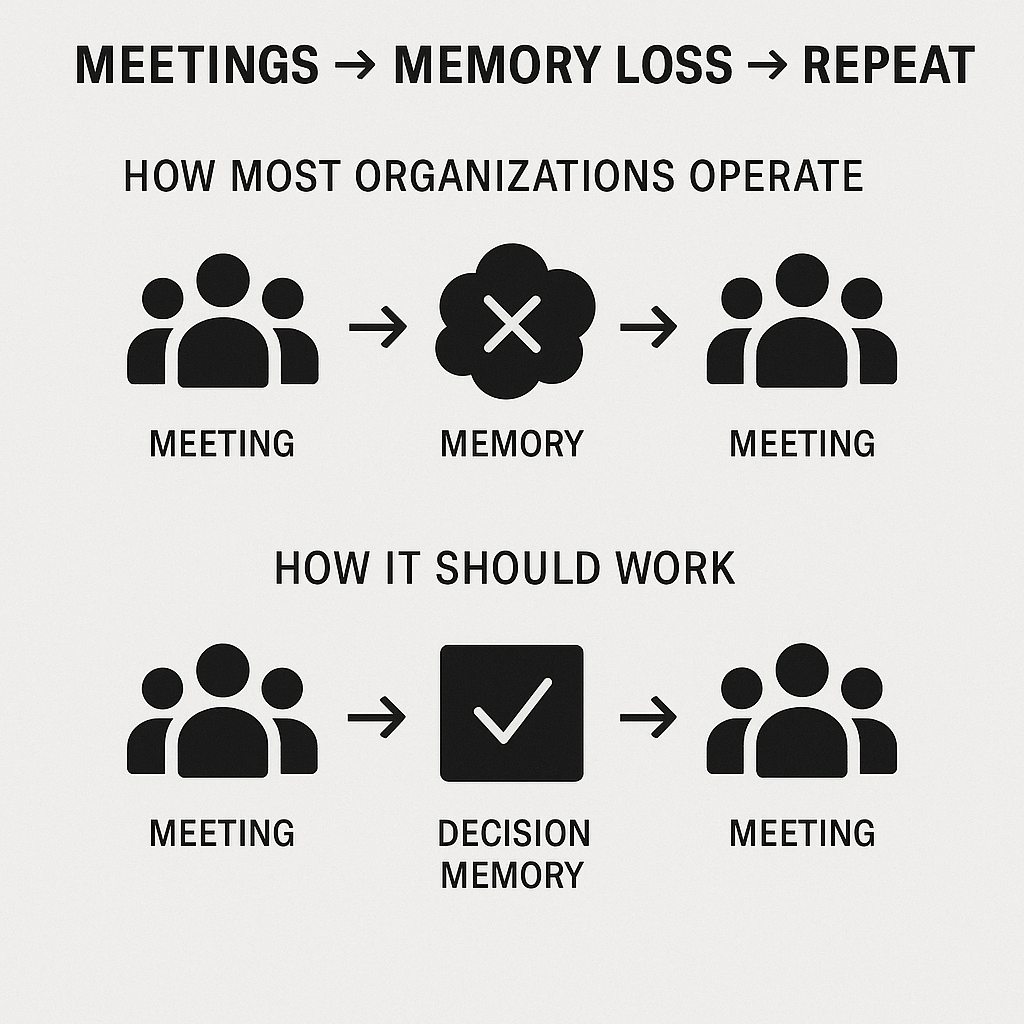
We don’t need fewer conversations. We need better organizational memory.
Every few months, someone declares meetings are broken.
And sure—many are.
They’re too long.
Too vague.
Too political.
Too frequent.
Too performative.
But blaming meetings for your company’s problems is like blaming a whiteboard for bad ideas.
The problem isn’t the gathering.
It’s what your system forgets the moment everyone leaves.
What Looks Like “Meeting Overload”
Is often a memory problem in disguise.
- Why are we having another alignment call?
Because no one remembers where the last decision landed. - Why are we debating the same thing again?
Because no one wrote down the rationale behind the previous choice. - Why are 8 people here?
Because the last 3 meetings had gaps in context, and now everyone wants to “be in the loop.”
The work isn’t stuck because you talk too much.
It’s stuck because the reasoning disappears.
And the system doesn’t remember what matters.
What Meetings Are Supposed to Do
In high-functioning orgs, meetings are:
- Memory resets
- Strategy translators
- Uncertainty compressors
- Judgment amplifiers
But most orgs don’t treat them that way.
They treat them like a one-time performance—
not a node in an ongoing chain of operational reasoning.
So everyone shows up.
Talks.
Nods.
Leaves.
And three days later, the next group starts from scratch.
AI Is About to Make This Worse—or Way Better
Now that AI is in the loop—summarizing meetings, taking notes, generating actions—we should be solving this problem.
But here’s the trap:
If all we automate is the recap,
we’re just scaling the same memory loss—faster.
Because bullet points ≠ context.
Meeting titles ≠ strategy.
Action items ≠ clarity.
The point of AI isn’t to remember more.
It’s to remember what actually matters—and help us evolve it.
What Companies Should Be Building Instead
Start designing for organizational memory like it’s infrastructure.
- Treat decisions as first-class objects.
Give them a place to live, evolve, and link to outcomes. - Track assumptions, not just actions.
What were we solving for? What did we choose not to do? - Use AI to build connective tissue, not just documentation.
Let it summarize trends across meetings, not just minutes. - Assign memory as a role.
Make someone accountable for context continuity—not just logistics.
One Last Thought
The real problem isn’t that we’re talking too much.
It’s that our thinking doesn’t compound.
So we start over.
We re-litigate.
We meet again.
Not because we want to—
But because we have to.
If your company had a memory as sharp as your best person?
You wouldn’t hate meetings.
You’d build on them.
That’s what’s under construction now.
More soon,
Gage Batten
Under Construction
How work is being rebuilt in real time