Most AI Use Cases Are Point Solutions. That’s the Problem.

Your AI isn’t failing. Your architecture is.
The demos are amazing.
You see an AI tool summarize calls. Or respond to tickets. Or write a press release.
It’s fast. Accurate. Feels like magic.
So you plug it in.
And... nothing really changes.
Everyone keeps working the same way.
The gains are isolated. The rest of the system stays clunky.
One part of the business is accelerating while the rest is still emailing PDFs.
That’s the pattern.
Because most AI use cases are still being dropped in as point solutions.
And that’s exactly why they’re stalling out.
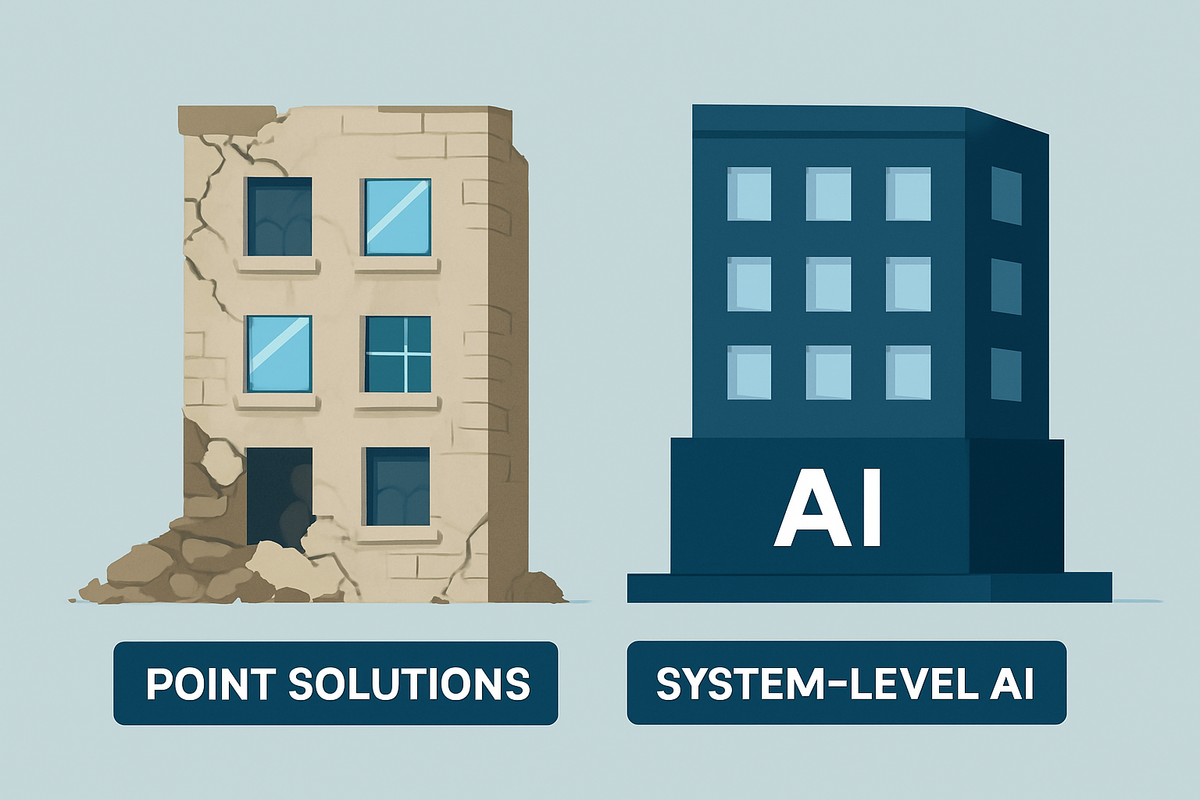
A point solution solves one task. A system rewires how value moves.
Most companies are sprinkling AI into specific tasks:
- “Summarize this meeting”
- “Write this support reply”
- “Draft this cold email”
These are helpful. But they live inside silos.
They improve a node, not the network.
The problem?
You optimize one part of the chain, but you don’t fix the chain itself.
So every gain hits a wall.
Example:
You use AI to generate reports faster. Great.
But the decision-making structure still runs through weekly meetings, with five layers of sign-off.
You’re still waiting seven days to act on information you got in seven seconds.
This is how ops debt compounds invisibly
You automate the output, but not the routing.
You reduce workload, but not complexity.
You accelerate the wrong parts, and leave the bottlenecks untouched.
You build tools around broken systems.
And then you wonder why the tools don’t change the game.
The tech isn’t failing.
The architecture is.
Point solutions are a trap because they scale the wrong thing
Here’s what that looks like:
- More responses, still no resolution.
The AI drafts replies, but no one follows through. - More dashboards, less clarity.
You have more data summaries than you know what to do with—because no one owns the decision loop. - Faster task completion, same slow throughput.
The work moves faster inside a box that’s still gated by human sign-offs and unclear ownership.
This is AI stuck at the surface level.
You're polishing tiles on a crumbling foundation.
The real win is systems-level AI
You don’t need more AI features.
You need AI-native flows.
That means designing entire processes where:
- The task is done
- The result is routed
- The context is preserved
- The follow-up is triggered
- The outcome is measured
- And all of that happens without hopping departments or guessing what comes next
Let’s put it plainly:
“AI-enhanced” is still reactive. “AI-native” is proactive.
Examples of the shift
Old:
You use an AI chatbot to reduce support volume.
New:
The bot triages, resolves, logs themes, routes to product, tags potential churn, and feeds insights into roadmap prioritization—automatically.
Old:
Your rep uses an AI copilot to write emails faster.
New:
The system identifies intent, drafts the response, schedules the follow-up, logs the CRM, and escalates edge cases for human judgment—end to end.
Old:
Your ops lead uses AI to summarize internal notes.
New:
Meetings are transcribed, decisions extracted, blockers flagged, and action items assigned to the right tool—before the calendar even clears.
This is what it looks like to think in systems, not features
The future of AI isn’t dozens of little tools bolted to broken processes.
It’s fluid systems that learn, act, and adjust in real time.
And that only happens when we stop thinking:
“What can AI do here?”
And start asking:
“What should this whole system look like now that AI is possible?”
What to do now
- Map one flow, end to end.
Where does work start? Where does it break? Where is the human still guessing? - Find the drop-offs.
Most point solutions fail in the handoffs. Design for continuity. - Shift from tools to outcomes.
Don’t deploy AI features. Solve problems. Track resolution, not just activity. - Treat context as a first-class input.
The best systems pass rich context forward. That’s how they stay smart.
You don’t win with more features.
You win with smarter systems.
The companies that get this right won’t be the ones with the most AI—they’ll be the ones who rebuilt around it.
More soon,
Gage Batten
Under Construction
How work is being rebuilt in real time