Stop Thinking in Departments, Start Thinking in Flows

Most companies are trying to modernize with the wrong map.
They’re adding AI to their processes, automating what they can, rolling out smart tools across every department and still hitting walls.
Still feeling slow.
Still solving the same problems twice.
Why? Because the org chart is optimized for centralized control not flow.
Departments and Titles are legacy architecture
Departments and Titles made sense in the industrial age.
You had clear functions. Clear handoffs. Clear lines of ownership.
Work moved like paper—literally—and your structure reflected that.
HR here. Finance there. Marketing over there.
It was neat. It was understandable.
And it worked.
Until it didn’t.
Today, work doesn’t move in boxes
Today, workflows don’t start and stop with one team.
They cut across roles, tools, systems, time zones, and now—intelligence layers.
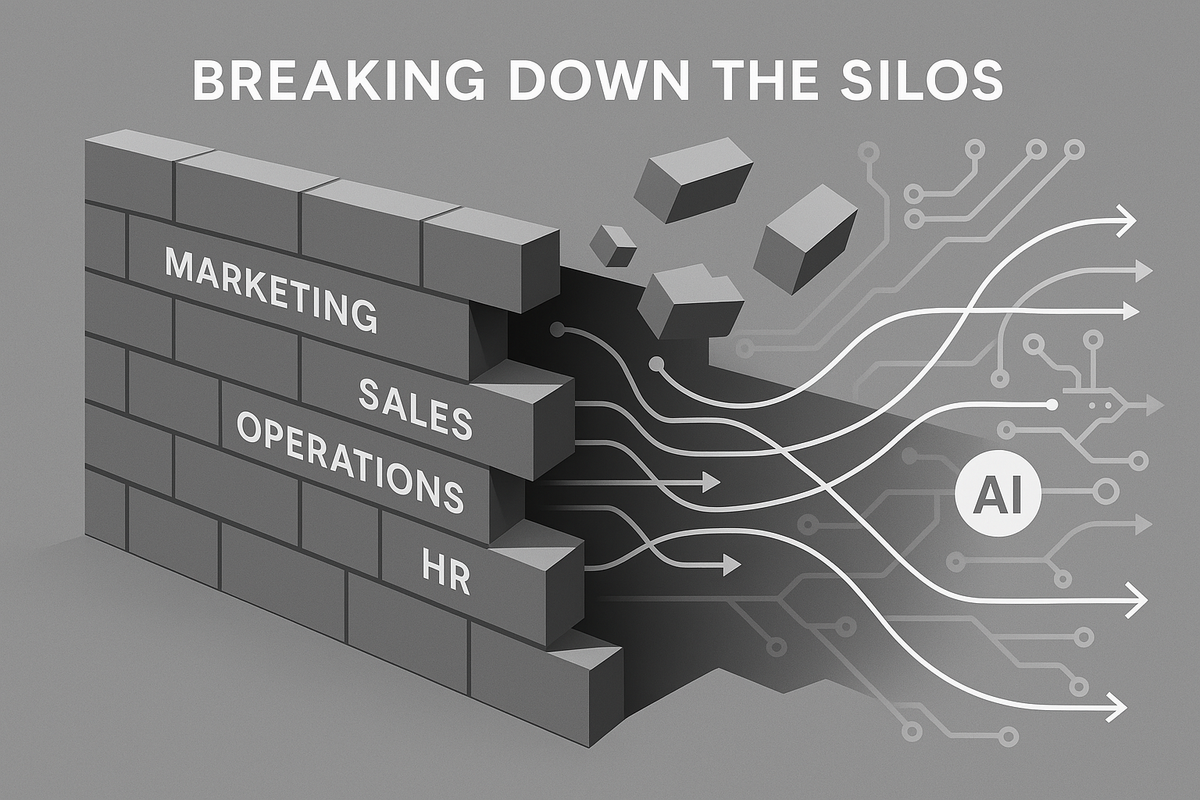
AI doesn’t respect org boundaries.
It doesn’t care if your marketing team is a separate function from sales.
It moves where the data lives, where the decision happens, where the next step is.
That’s the shift most orgs are missing.
Silos look safe, but they’re bleeding value
Take this scenario:
A customer submits a support ticket.
The AI assistant replies.
Great. First contact resolution.
Except that assistant didn’t surface the follow-up for success.
It didn’t log the insight for marketing.
It didn’t flag the billing inconsistency to finance.
No one saw the churn signal.
Everyone did their job.
But no one saw the flow.
That’s how you get clean dashboards and broken businesses
AI makes the cracks louder
The faster the machine moves, the more painful the misalignment becomes.
An AI assistant doing triage touches multiple parts of the company.
- Ops sees ticket volume go down.
- Product sees fewer feature requests.
- Finance sees deferred refunds.
- Success sees increased churn.
No one’s wrong. But no one has the full picture either.
Because everyone’s looking from inside their silo, not across the whole system.
So what’s the alternative? Think in flows.
A flow is how value moves through your business.
End to end. Edge to edge.
It's how a lead becomes a customer.
How a ticket becomes a referral.
How a task becomes a result.
When you start designing around flows, not functions, things shift:
- You stop asking “Whose department owns this?”
- You start asking “Where is the process breaking?”
- You stop optimizing for coverage.
- You start optimizing for velocity + clarity.
Flows cut through departments.
They make friction visible.
And they force you to answer the one question the org chart avoids:
Does this structure actually support the way we work today?
Here’s what this looks like in practice
Don’t launch another AI tool per department
Instead, map a cross-functional journey (like onboarding or incident response) and embed AI across the full sequence.
Stop measuring silo performance
Track resolution time across the entire flow. Track signal loss between handoffs. Measure human override rate.
Think in systems, not snapshots
The AI doesn’t just automate tasks—it connects them. If you’re not thinking about what happens between steps, you’re missing half the value.
What this means for leadership
Your org chart is a vestige.
A comfort structure. A political artifact.
But your workflow architecture—how things actually get done—is where all the action is.
And right now, for most companies, those two systems don’t match.
Here’s the future:
- Organizations structured around flows, not titles
- Teams built to coordinate, not control
- Roles designed for adaptability, not territory
- AI as a horizontal layer, not a departmental add-on
- Strategy defined by motion, not hierarchy
The big question:
If you were building your company from scratch today—
with AI as the default, and flow as the design principle—
would your org chart look anything like it does now?
Probably not.
The opportunity isn’t just to automate what’s broken.
It’s to rebuild around how work actually works now.
If you’re already mapping this—or wrestling with how to start—let’s talk.
This shift is happening fast. And the companies that win won’t be the ones with the best AI tools.
They’ll be the ones with the clearest flows and the least friction.