The AI Mirage: Why Velocity Without Direction Is Just Burnout at Scale

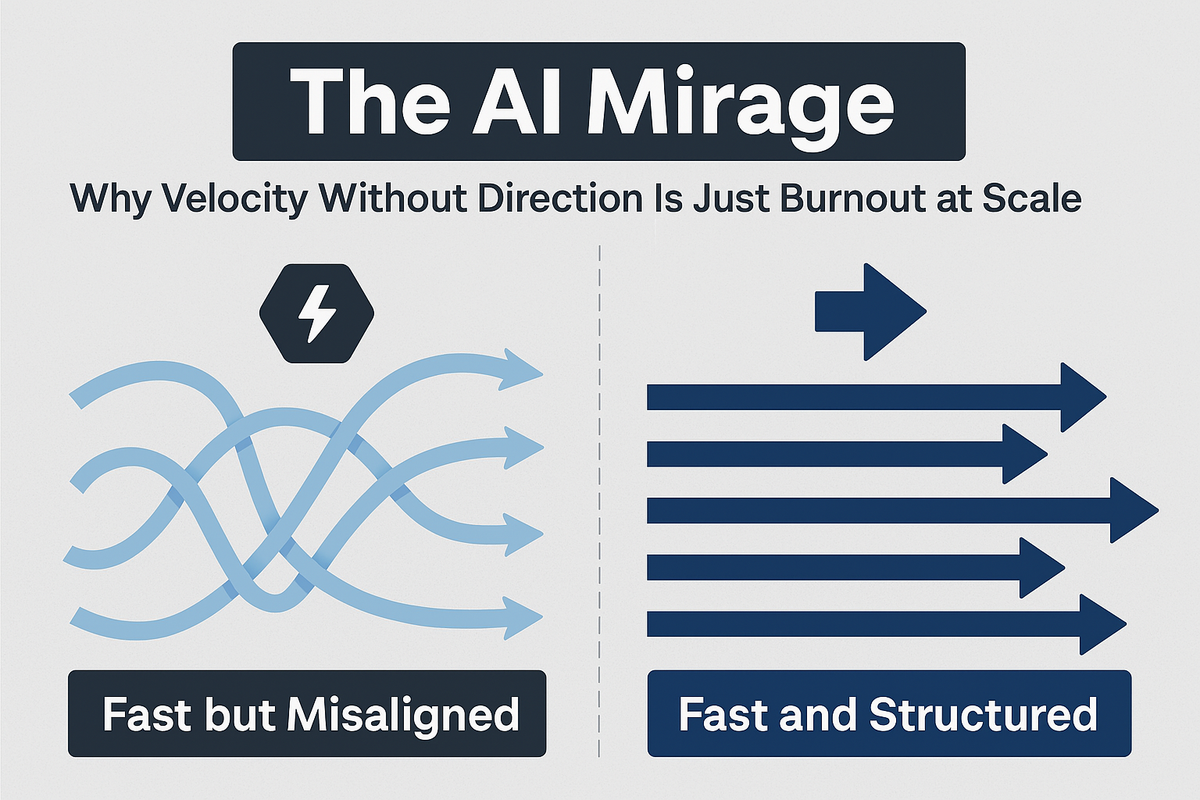
Speed without structure is just waste in disguise
The most common pitch in this new AI era is speed.
Faster decisions. Faster writing. Faster tickets. Faster code.
And on paper, it delivers.
But if you scratch beneath the surface, a pattern emerges—teams are working faster, and feeling worse.
Why?
Because without clear direction, AI-driven speed just accelerates confusion.
Velocity isn’t the problem. Direction is.
We’ve been sold a story:
“If your people are moving faster, your company is doing better.”
But if the system they’re operating inside is misaligned—
if the incentives are outdated, the workflows are unscoped, and the goals are muddy—
then all AI is doing is helping you burn out faster.
How this shows up in real ops
Content and Comms
Your AI assistant can generate five versions of an email campaign in minutes.
But no one agreed on the positioning.
So now you’re stuck reviewing copy that’s fast—but off-target.
Internal Automation
You deploy AI to speed up ticket routing.
Tickets move faster—but they bounce back twice as often.
Because no one updated the decision logic on the backend.
Reporting
You ask AI for a dashboard of last week’s metrics.
It gives you beautiful charts.
But no one decided what good looks like.
Now you’re spending time decoding graphs that didn’t need to exist in the first place.
You’re not moving forward. You’re just moving.
The AI mirage is this:
You feel productive.
Everything’s flowing.
There’s motion everywhere.
But if you look closely, nothing is actually resolving.
Decisions are delayed.
Backlogs shift but don’t shrink.
Outputs increase—but outcomes stall.
This is how you burn out high-performers
People feel like they’re drowning in inputs:
- More data
- More prompts
- More tools
- More requests
- More follow-ups
But the decisions aren’t getting clearer, and the goals aren’t getting tighter.
So they grind harder. Faster. Longer.
And eventually tap out—not because of the volume, but because of the vagueness.
AI didn’t break your ops. It revealed that they weren’t built to scale.
When things were slower, human intuition papered over the cracks.
Now AI removes the friction—and exposes the structural gaps:
- No agreed-upon direction
- No decision criteria
- No definition of “done”
- No owner of the loop
- No architecture for flow
So your system floods.
And speed becomes your enemy.
The fix is upstream of the AI.
AI isn’t the fire. It’s the accelerant.
And without clear strategic constraints, it just lights everything on fire faster.
So before you build faster tools, you need to ask:
- What are we actually trying to solve?
- Where are we sending this output? Who owns it?
- What’s the resolution condition—not just the task?
- What’s the cost of doing this wrong, fast?
- Where are we measuring motion, not progress?
This is the next layer of ops maturity
The first wave was:
Use AI to move faster
The next is:
Use AI only where direction is clear, outcomes are defined, and ownership exists
And beyond that:
Rebuild your work architecture so velocity compounds rather than fragments
Speed is no longer the bottleneck.
Alignment is.
Clarity is.
Structure is.
AI doesn’t solve for those.
You do.
More soon,
Gage Batten
Under Construction
How work is being rebuilt in real time