The Death of Default Settings

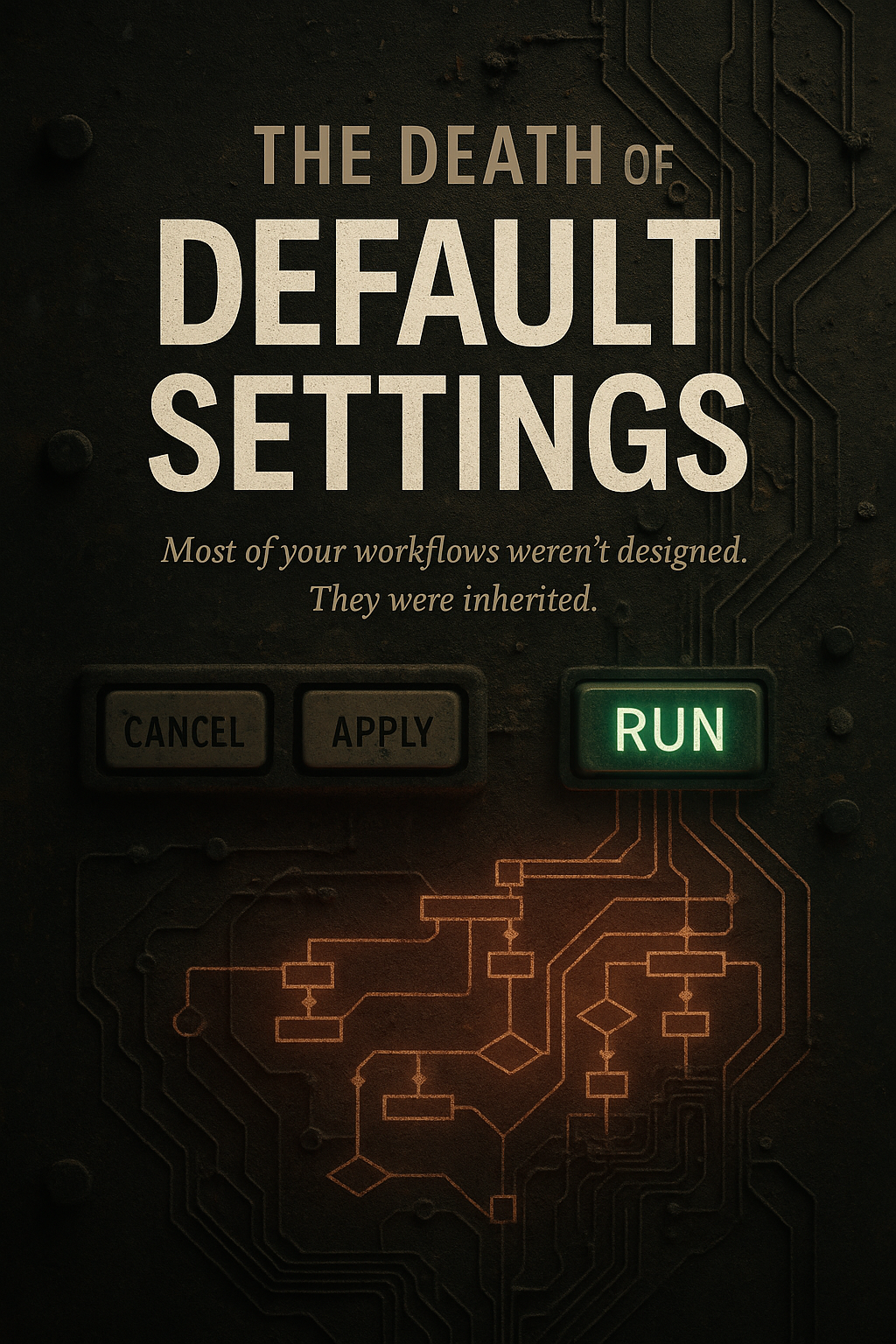
Most of your workflows weren’t designed. They were inherited.
You’re not running the business you think you are.
You’re running:
- Old assumptions
- Forgotten workflows
- Templates you never Built
- Permissions no one ever reauthorized
- Automations built on logic no one remembers writing
And the most dangerous part?
Most of it still technically works.
That’s why no one touches it.
Because it isn’t broken—just invisible.
Just good enough to avoid scrutiny.
Just quiet enough to avoid blame.
But now?
With AI accelerating everything?
That invisible stack of defaults isn’t just friction.
It’s fragility.
Your Company Is Being Quietly Run by Inheritance
You didn’t design that intake form.
You didn’t architect your approval logic.
You didn’t choose the sequence of handoffs, tags, roles, or alerts.
They came with the software.
Or the department.
Or the last person who held the job.
And now AI is surfacing all of it—because it has to know:
“What happens next?”
And for the first time in years, you have to admit:
“I don’t actually know.”
You Think You’re Scaling Ops.
You’re Actually Scaling Ghost Code.
AI doesn't question your logic.
It executes it.
It doesn’t pause to ask if that flag still means what it did in 2020.
It doesn't know that “pending” means “stuck” in your culture.
It doesn’t sense when a person is waiting for a Slack DM before moving forward—even though the task status says “in review.”
It runs the system you give it.
And if your system is rotten?
It just rots faster.
This is the trap.
You’re not scaling clarity.
You’re scaling legacy logic wrapped in modern speed.
And no one notices until something important slips through—and it’s nobody’s fault.
AI Isn’t Replacing You.
It’s Stress Testing the System You Forgot to Maintain.
The biggest myth in AI discourse right now?
That it will “replace people.”
No.
AI is replacing ambiguity.
And if your operations are built on assumptions, tribal knowledge, and slack-fueled memory?
AI is about to replace that too.
Not by automating it.
By breaking it.
What the Sharpest Leaders Are Doing Now
They’re not just deploying AI.
They’re interrogating every invisible decision baked into their business:
- Why does this trigger that?
- Who actually owns this step?
- Why do we still do this in three systems?
- What are we assuming here—and should we?
They’re asking:
“If we had to rebuild this from scratch today, would we build it this way again?”
And if the answer is no, they don’t patch it.
They kill it.
Because the real ROI of AI doesn’t come from faster output.
It comes from finally seeing the machinery beneath your business—and having the guts to rewire it.
One Final Thought
Your company is filled with decisions no one remembers making.
And workflows no one remembers approving.
And automations no one remembers updating.
They’re still running.
Still shaping outcomes.
Still affecting customers.
And now that AI can act on all of it?
You don’t just have a workflow problem.
You have a governance problem at scale.
The organizations that win this era won’t be the ones that adopt AI the fastest.
They’ll be the ones that stop mistaking inherited design for intentional design.
Because speed doesn’t make bad systems better.
It just makes them irreversible faster.
This is your chance.
Not to optimize the defaults.
To kill them.
And start designing for the business you actually want to run—not the one you who's systems you quietly inherited.
That’s what’s under construction now.
More soon,
Gage Batten
Under Construction
How work is being rebuilt in real time