The Future of Work Isn’t Fewer People. It’s Fewer Hand-Offs.

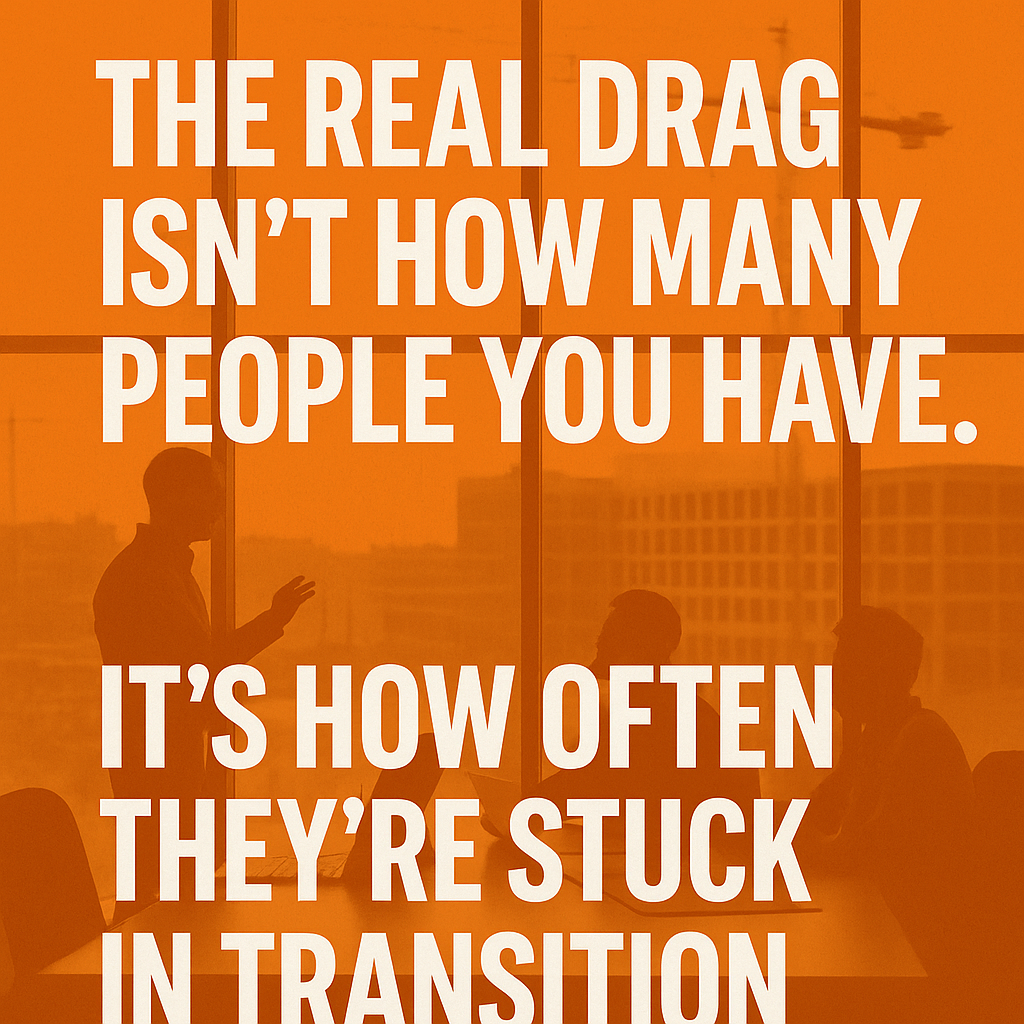
The Next Leap in Productivity Isn’t Who You Hire—It’s How Work Moves After You Do
Why the real problem at work isn’t capacity. It’s choreography.
We’ve been sold a simple future:
Smaller teams.
Fewer people.
More automation.
A future of clean dashboards and lean org charts.
Efficient. Controllable. Predictable.
But zoom in. Look closer.
Work doesn’t break in the org chart.
It breaks in the space between the boxes.
The friction isn’t just in what gets done—
It’s in how it moves once it is.
The Problem Lives in the Gaps
Every team depends on momentum.
One person finishes. The next one starts.
But hand-offs are rarely clean.
- The “final” file never makes it to the next owner
- A decision gets made—but not shared
- A task is complete—but no one knows what that means
It’s not sabotage. It’s not laziness.
It’s the quiet cost of unmanaged transition.
These moments don’t show up on dashboards.
But they show up everywhere else—
In delays. In confusion. In work that happens twice.
And the worst part?
No one owns the space between.
A Scene You’ve Seen Before
The product design is done. Deck is approved. Shared.
Except ops didn’t know.
The vendor never got looped in.
Marketing is waiting on specs.
Launch day drifts past quietly.
Everyone did their job.
And still—something got dropped.
That’s not a staffing issue.
It’s a handoff failure.
And they happen thousands of times a day.
Why This Gets Worse the Faster You Move
In slow, linear work, you can buffer for confusion.
But in project-based, cross-functional, fast-moving environments?
The only thing holding your operation together is clean transition.
Construction. Creative. Tech. Events. Agencies.
Work gets done by overlapping, interdependent teams under pressure.
And in that world, the gaps are fatal.
Not because people aren’t good—but because the system assumes someone will “figure it out.”
We plan the project.
We forget to plan the baton pass.
What AI Can—and Can’t—Fix
Yes, AI is helping:
- Summarizing meetings
- Flagging blockers
- Pre-writing action items
- Notifying the next person
But AI doesn’t decide what clarity means in your org.
It doesn’t assign ownership.
It doesn’t define what “done” means.
It doesn’t ask the awkward question when something doesn’t feel right.
That’s still on you.
Soon, AI will track handoff lag, simulate downstream risks, even nudge teams before a stall happens.
But if you haven’t designed the expectation of clarity into your system?
The tech won’t save you.
This Isn’t About Tools. It’s About Trust
We used to think the task was the hard part.
Now we know: getting the task into the right hands, at the right time, with the right context—is the hard part.
And it often fails because we:
- Assume instead of confirm
- Imply instead of assign
- Deliver instead of transition
Leadership isn’t just knowing what needs to be done.
It’s making sure someone else knows they’re up next—and nothing gets lost in the space between.
One Last Thought
Most teams don’t need more headcount.
They need fewer moments of ambiguity.
So find your 3–4 repeat handoff failures.
The spots where things always stall.
And redesign those transitions until they’re unmissable.
Because the future of work won’t be defined by how much we automate.
It’ll be defined by how little we drop.
And maybe the best teams won’t be the ones who move the fastest—
But the ones who never break rhythm.
More soon,
Gage Batten
Under Construction
How work is being rebuilt in real time