The Google Trap: Why Most People Aren’t Actually Using AI

Just because you’ve opened ChatGPT, typed a question, and gotten a response…
doesn’t mean you’re using AI.
You’re Not Using AI. You’re Just Asking Questions.
Let’s get one thing straight:
Millions of people are interacting with AI every day—
but most are still stuck in search mode.
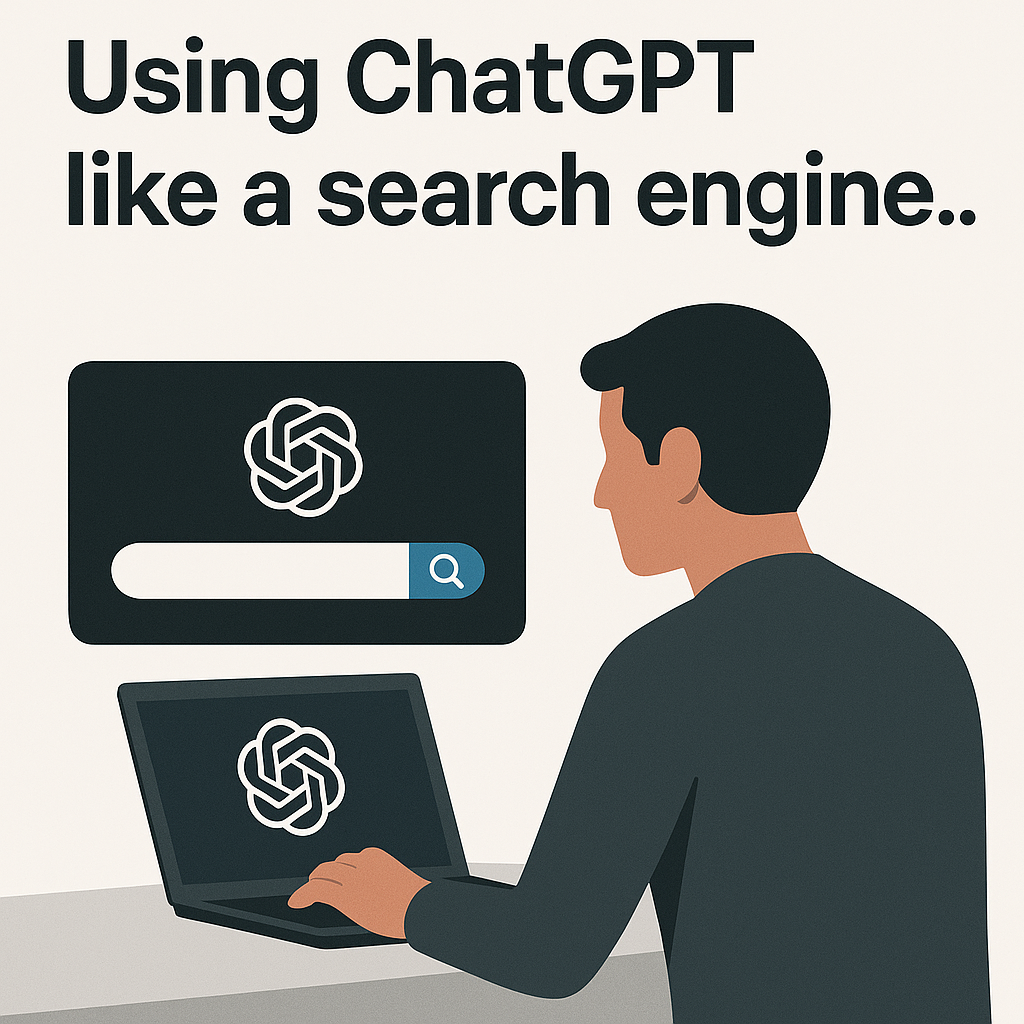
They treat a multimodal reasoning engine like a polite version of Google.
Then wonder why it doesn’t feel transformative.
Because very few are actually using it like AI.
Open someone’s history and you’ll see it:
One-off threads.
No follow-ups.
No context.
No planning.
No creativity.
Just Google, with a different font.
What This Looks Like
I’ve seen this play out in real time.
Someone proudly tells me, “I use ChatGPT every day.”
I ask to see their history.
The threads?
Each one starts with a single prompt:
“When did the Roman Empire fall?”
“Who’s in the cast of Dune?”
“What’s a good workout split?”
And then—nothing.
No follow-up. No refinement. No build-up. No memory. No planning.
Just a new thread.
Then another.
Then another.
It’s not usage. It’s convenience.
It’s treating a multimodal reasoning system like a more polite search bar.
What They’re Missing
The real danger isn’t that people are using AI superficially.
It’s that they think they’re fluent because they’re familiar.
They’ve had access to an Allen wrench for two years.
They assume they’re now an advanced mechanic.
But using AI like a search engine is like piloting a fighter jet just to taxi down the runway.
You’re sitting in a machine capable of multi-step reasoning, recursive planning, simulation, and strategy.
People think they’re “using AI” when they’re really just skimming the surface.
And that’s fine—until they confuse casual use with mastery.
It’s like someone who’s owned an Allen wrench for two years and starts calling themselves a mechanic.
The difference between AI awareness and AI fluency is massive.
Awareness is typing questions.
Fluency is structuring workflows.
Fluency is teaching the model to think with you.
Fluency is multi-step reasoning. Memory use. Strategic scaffolding. Role-based thinking. Planning with constraints.
If you’re not doing that, you’re not behind—you’re just early.
But don’t confuse tool exposure with capability.
How to Escape the Google Trap
Start with this:
If ChatGPT feels underwhelming to you, you’re probably using it wrong.
Here’s how to fix that:
- Stack your questions instead of asking one at a time
- Feed it context before asking for decisions
- Assign it a role, not just a task
- Use memory and follow-up to teach it how you think
- Build structured prompts for repeatable workflows
- Ask it to challenge your assumptions, not just confirm them
Think of it this way:
If you’re not occasionally surprised by ChatGPT, you’re not exploring deeply enough.
And if you’re never building on prior outputs, you’re not actually collaborating—you’re just querying.
The Divide Is Already Forming
Everyone’s using AI.
But they’re not using it the same way.
On one side:
Linear Users.
They ask single questions.
They collect one-off answers.
They treat AI as a more conversational Google.
On the other side:
Compounding Users.
They build workflows.
They chain reasoning.
They design prompts like systems.
They don’t just ask questions—they teach the model how they think.
This is the divide that matters.
Because the ones on the compounding side?
They’re already moving faster.
They’re doing more with less.
And they’re building leverage that scales.
Which side are you on?
You’re Not Behind—Yet
If you’ve been using AI like Google, that’s okay.
It’s familiar.
It’s safe.
And to be fair, it’s still useful.
But don’t confuse exposure with capability.
Don’t confuse tool access with fluency.
The real value of AI shows up when you stop querying and start looping.
When the model becomes your mirror, your sounding board, your sandbox.
When you begin to see your own thought process evolve through interaction.
This Isn’t About Tools—It’s About Mindset
At some point, we’re going to stop talking about “AI tools” altogether.
They’ll just be the way we interact with our own ideas, our work, and each other.
The shift won’t be obvious.
It will be quiet, like most revolutions.
And the people who adapt early won’t shout about it.
They’ll just move differently.
Because the next era of work won’t belong to those who simply use AI—
It will belong to those who know how to think with it.
More soon,
Gage Batten
Under Construction
How work is being rebuilt in real time