The Quiet Disruptions Part 2: The Silent Replacement of Middle Layers

You won’t see a headline that says “AI replaces coordinators.”
You won’t see a pink slip titled “GPT took my job.”
But the shift is underway.
It’s subtle, structural, and already happening:
AI is replacing the middle—not the top, not the bottom—the middle.
And most organizations haven’t realized what that means yet.
What is the middle layer?
The middle layer is connective tissue.
It’s not the execs setting vision.
It’s not the operators doing execution.
It’s the interpreters, synthesizers, translators, and trackers:
- The project coordinator pulling updates from six tools
- The analyst summarizing reports for decision-makers
- The product ops person translating between engineering and marketing
- The assistant writing recaps and assigning tasks post-meeting
- The team lead manually routing tickets or monitoring bottlenecks
They weren’t doing the core work.
They were orchestrating it.
Now AI is starting to do that orchestration—quieter, faster, and 24/7.
Where it’s already happening
- Customer support escalation is being triaged by AI before a manager ever sees the ticket
- Meeting summaries, task assignments, and follow-ups are auto-routed by copilots or agents
- Dashboards pull real-time data and make recommendations, reducing the need for weekly reviews
- Content briefs are generated by LLMs based on trends and prior messaging—before the strategist even starts typing
- Cross-department status updates are fed into a prompt, turned into a narrative, and delivered directly to stakeholders
None of this replaces people entirely.
But it diminishes the need for someone in the middle to hold it all together.
The illusion of busyness is fading
These roles have traditionally been justified by the friction in the system:
- The gaps between tools
- The gaps between teams
- The gaps between intentions and execution
AI closes those gaps.
Or, at the very least, it makes them traversable without a person acting as the bridge.
So now the job becomes… what, exactly?
This doesn’t mean “lay off the middle” — it means redefine it
The middle layer isn't going away—it’s just being forced to evolve:
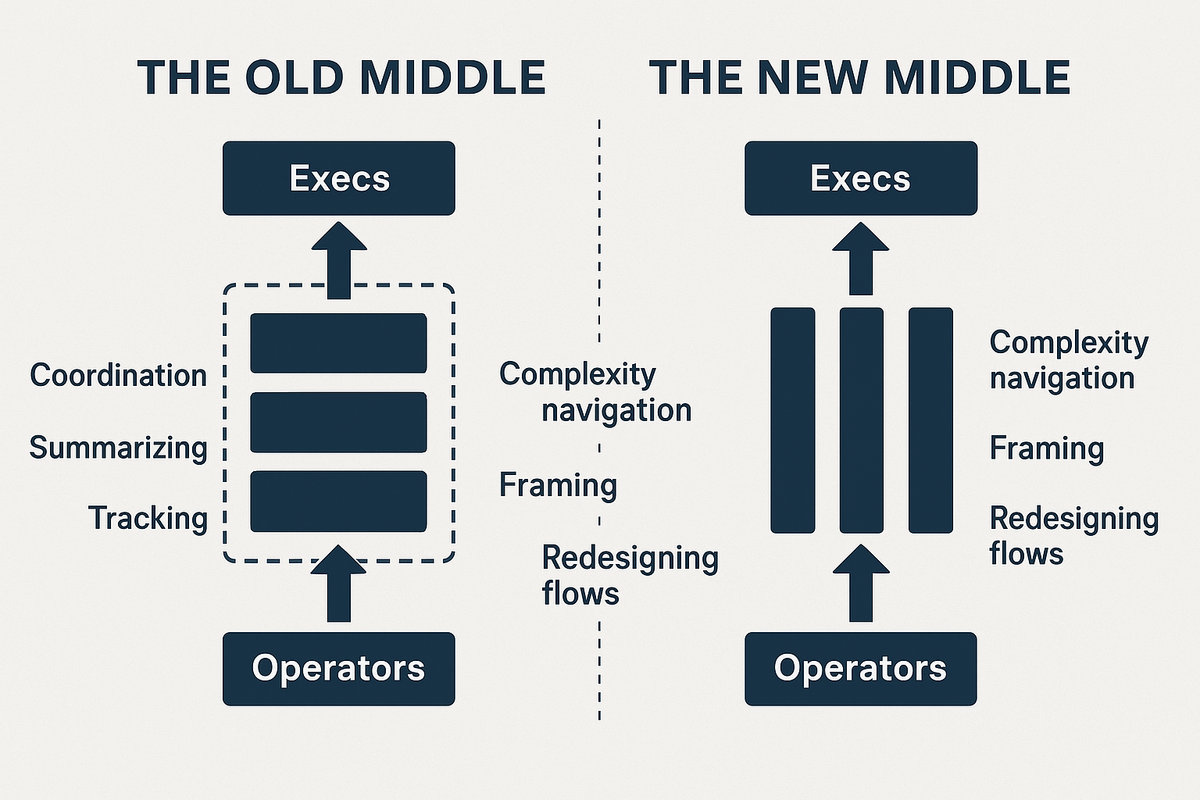
- From coordination → to complexity navigation
- From summarizing → to framing
- From tracking → to redesigning flows
- From proxy decision-making → to owning edge cases AI can’t model
The new middle layer will be made of:
- People who understand both systems and humans
- People who can adjust rules, not just follow them
- People who understand the flow of work and not just the form
It’s not “middle management.”
It’s systems leadership.
This is how you build leverage, not redundancy
Want to future-proof your team?
Redesign your middle layer like this:
- Treat coordination as code
Anything that happens repeatedly should be systematized. Humans should be writing the logic, not running the loop. - Uplevel middle roles to architect flow
If someone’s job is to “gather updates,” ask why the updates aren’t visible. Fix that. - Track decisions, not check-ins
The goal isn’t “who’s doing what.” It’s “what was decided, and why?” Build tools to reflect that. - Promote the interpreters who can ask better questions, not just report faster answers
The middle was never meant to scale. That’s why it’s breaking now.
AI is showing us that most of what middle layers do can be translated, tagged, routed, and summarized.
The future of leverage lies in designing systems where the middle:
- Adds intelligence
- Applies discretion
- Structures ambiguity
- Owns decisions AI can’t make
Everything else?
The system will handle it.
More soon,
Gage Batten
Under Construction
How work is being rebuilt in real time