The Quiet Disruptions Part 3: What Comes After the Dashboard

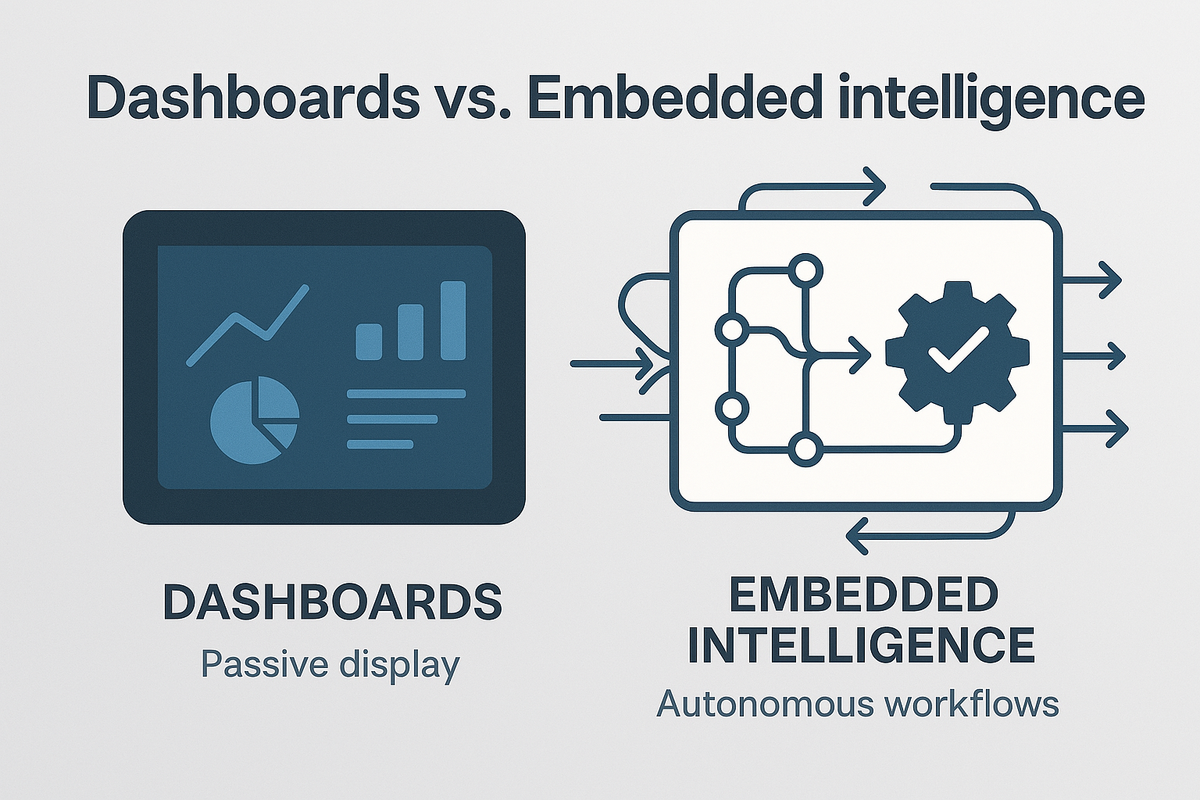
Dashboards gave us visibility. Now what?
The dashboard was a milestone.
It gave us real-time visibility into what used to be opaque:
- Sales funnels
- Burn rates
- Construction timelines
- Support tickets
- Team capacity
But in a world where everything is already structured, tagged, and flowing through intelligent systems, the dashboard isn’t the frontier anymore.
It’s a mirror.
Useful, yes—but increasingly passive.
The real leverage?
What happens the moment after the dashboard is read.
The dashboard used to be the control room
Executives, team leads, project managers—everyone used to gather around dashboards like radar screens.
- “What’s happening?”
- “Are we off track?”
- “What changed?”
The answers lived inside dashboards because they lived nowhere else.
But now, decisions don’t wait for Monday morning metrics.
They’re embedded in the workflow.
AI agents act on triggers.
Routing happens autonomously.
Workflows self-adjust based on input data.
The dashboard becomes a spectator sport unless it’s wired into a feedback loop.
Dashboards are becoming outputs—not interfaces
Here’s what’s changing:
| Legacy Use | AI-Native Replacement |
|---|---|
| Manual dashboard reviews | System-triggered alerts with recommended actions |
| Snapshot visualizations | Continuous telemetry + feedback loops |
| Human-led prioritization | Workflow-level automation and routing |
| Summary for discussion | Actionable tasks with embedded context |
Instead of seeing what's happening—
You get what to do about it.
And increasingly, the system acts before you even ask.
This is the end of reporting-as-leverage
If your value in an organization is translating dashboards into actions, you’re already being replaced—quietly.
Not because you weren’t good at it.
Because the system can now watch itself.
And move.
So the leverage shifts:
From who can see the data—
To who designs the system that reacts to it.
What comes after the dashboard? Autonomous workflows + interpretable infrastructure
We’re entering a phase where:
- AI agents monitor leading indicators
- Systems self-correct against baselines
- Ops leaders shift from watching metrics to designing incentives
- Decision logs become infrastructure
- Human oversight focuses on exceptions, not aggregates
The dashboard becomes one tool in a much larger architecture—and no longer the decision engine.
What to do now
- Track actionability, not visibility
For every dashboard you have, ask: What decision does this support, and is it still manual? - Replace status reviews with telemetry logic
Build triggers. Automate nudges. Let the system talk to itself before it escalates to a person. - Design your workflows like control systems
Inputs → Observations → Adjustments → Logs → Feedback - Upgrade your dashboard from “reporting” to “interfacing”
Where possible, make dashboards interactive agents that allow intervention, not just observation.
The question isn’t what your dashboard shows. It’s what your system does with it.
The next layer of visibility is embedded intelligence.
The AI doesn’t just tell you what changed—it decides if it matters.
And it moves before you even open the tab.
Your job?
Design the systems.
Define the thresholds.
Audit the assumptions.
And build trust in what the dashboard no longer needs to say out loud.
More soon,
Gage Batten
Under Construction
How work is being rebuilt in real time