The Work That Remains Part 1: The Disappearing Edge

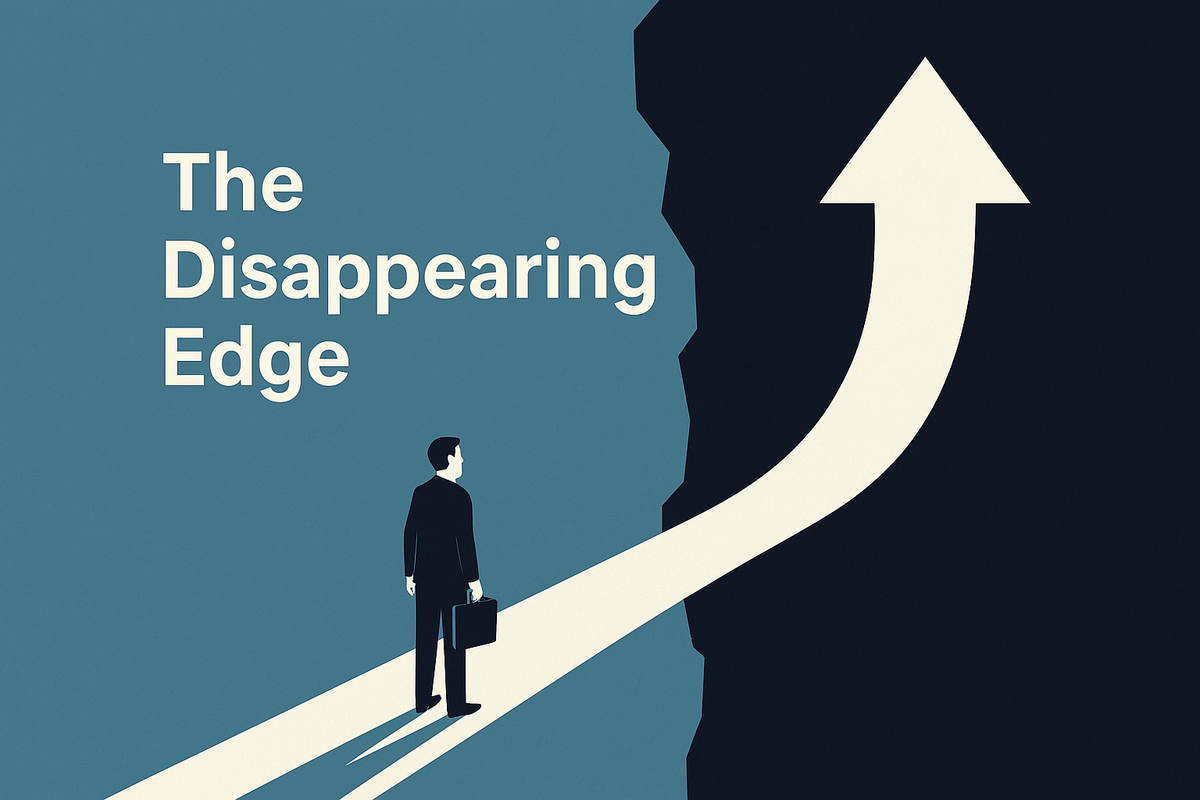
People spent entire careers developing expertise. Organizing, interpreting, executing, presenting—these skills once separated the indispensable from the replaceable.
Now, quietly and quickly, things have changed. These same skills are handled, at least partly, by AI and LLM systems that operate continuously, at negligible cost, and without fatigue. And if we’re totally honest, they’re getting very good at it.
This shift isn’t about replacement. It’s about redefining where human value sits.
When Skills Become Commodities
Consider an analyst who once spent years mastering the art of financial modeling. Today, AI can build sophisticated analyses instantly. The client no longer asks, “How was this calculated?” but rather, “What’s the story behind the numbers?” The analyst’s edge moves from calculation to storytelling.
Take the scheduler who expertly managed complex meeting logistics. AI now handles schedules effortlessly. The executive no longer needs to know when the meeting is possible, but rather, who needs to be in the room at all. The scheduler’s edge shifts from coordinating logistics to strategic prioritization.
An estimator who once spent days meticulously assembling cost breakdowns now receives detailed estimates from AI in minutes. Clients no longer ask how the number was calculated; they ask about the accuracy, risk, and practical implications behind it. The estimator’s edge shifts from generating figures to evaluating their reliability and strategic fit.
A project manager once dedicated hours each week manually reviewing extensive progress data, trying to determine true project status. Today, AI generates comprehensive progress reports instantly. The challenge is no longer acquiring data—it’s distinguishing meaningful signals from misleading noise. The project manager’s value shifts from simply gathering information to accurately interpreting and acting upon what truly matters on-site.
The Quiet Panic
Tasks that once defined a job now merely grant you entry to the conversation:
- AI writes your summary.
- AI cleans your schedule.
- AI outlines your brief.
- AI analyzes your spreadsheet.
- AI transcribes your calls.
- AI suggests decisions.
What was previously a final product for some has become a starting point now. And this shift creates an uneasy feeling—why did a task that used to take hours now only take seconds? Why does AI’s work feel simultaneously efficient and hollow?
That feeling isn’t imposter syndrome; it’s clarity. AI reveals precisely what tasks can easily be decoupled from human effort. What's left behind are the roles and tasks uniquely suited to human judgment.
Your New Edge: From Execution to Discernment
AI can propose dozens of paths, but only a human leader can determine which aligns with organizational values.
AI can suggest solutions, but only a skilled mediator can identify the unspoken tensions beneath.
AI can deliver data, but only a strategist can see subtle gaps in context or missing perspectives.
In short, AI executes tasks. Humans curate outcomes.
The New Way to Work
Old work focused on:
- Doing tasks quickly and precisely
- Delivering exactly what was requested
- Repeating processes reliably
New work demands:
- Clearly defining problems
- Setting intelligent constraints
- Directing the system toward the right goals
- Intervening when AI overlooks critical nuance
- Adapting quickly when assumptions inevitably shift
This is not advanced AI usage—it’s what genuine human value looks like when information is abundant, but meaningful context remains scarce.
Looking Ahead: Your Next Edge Isn’t Faster—It’s Deeper
Doing tasks quickly used to be enough. Soon, it won’t even get you in the door. In a world where AI instantly completes tasks that once required specialized expertise, speed alone is meaningless. What counts now is identifying value before others see it. Your future edge isn’t execution—it's anticipation.
Frame Problems Instead of Just Solving Them
AI excels at finding answers, but it’s indifferent to which questions matter most. The new skill isn’t giving instructions, it’s shaping which instructions to give. Spend more energy clearly defining challenges, sensing friction before it surfaces, and guiding AI toward genuinely valuable problems—not just the obvious ones.
Turn Nuance into Advantage
Data is easy; intuition is scarce. The subtle, unspoken signals—in politics, relationships, culture—are exactly what AI consistently misses. Sharpen your ability to spot hidden dynamics, ask uncomfortable questions, and address complexities that don’t neatly fit a dataset.
Move Beyond Tasks to System Thinking
Tasks are becoming commodities. True differentiation comes from understanding how those tasks connect and interact. Your value will increasingly come from seeing the flow across roles and silos. Learn how decisions cascade through your organization, and design systems that integrate seamlessly, not just independently.
Master the Skill of Discernment
Rapid evaluation is your new baseline. AI offers endless options; your role is quickly identifying which ones matter. Learn to instinctively trust AI’s outputs—and when your judgment must override them. Discernment isn’t a nice-to-have. It’s your new operating system.
Develop Your Sense of Taste
AI is limitless in creation, but humans remain unmatched in curation. Your real value is knowing what “good” means and clearly defining it. Cultivate your ability to see quality, context, and relevance—and ensure your team learns to see it too.
Your next edge is less about what you do, and more about how clearly you see, how thoughtfully you decide, and how precisely you guide the systems around you.
Emerging Trends Leaders Should Anticipate
Embedded Intelligence: From Dashboards to Contextual Insight
The traditional dashboard is rapidly becoming obsolete. Information previously confined to static reports or isolated visualizations will soon appear seamlessly within your daily workflows. Rather than searching for data, the right insights will surface precisely at the moments decisions are made.
For leaders, this means shifting focus away from periodic reviews toward continuous, integrated awareness. Your role will evolve from interpreting historical snapshots to responding strategically in real-time. The best leaders will build teams that can recognize and act upon embedded insights quickly, turning data into immediate and practical action.
Ask yourself:
- Which decisions currently require manual information-gathering that could be automated?
- How can your team evolve from consuming static data to acting upon embedded insights as they arise?
Autonomous Decision Networks: Managing Systems, Not Tools
AI tools are moving beyond isolated point solutions to interconnected decision networks—ecosystems of intelligent agents that coordinate and communicate independently. Rather than overseeing individual applications, your task will become designing, monitoring, and optimizing entire networks of AI-driven workflows.
This demands a new kind of leadership. You won't manage tasks; you'll orchestrate systems. Leaders must become skilled at defining guardrails, setting clear accountability frameworks, and ensuring alignment across complex decision chains. Mastering this shift will be a key competitive advantage.
Ask yourself:
- How can you ensure your AI ecosystem aligns with organizational goals and values, not just efficiency?
- Are you currently equipped to manage and optimize entire decision networks rather than individual tools?
Human-AI Co-evolution: Becoming Fluent in AI Collaboration
AI is moving beyond passive tools that respond to specific instructions. Increasingly, your role as a leader will involve actively shaping and learning alongside AI systems. Rather than merely issuing commands, you'll engage in a continual, reciprocal learning relationship, refining both your team's skills and the AI itself.
Leadership here means fostering an environment where people and AI iteratively improve together. You’ll coach teams not just in technical skills but in how to collaborate effectively with AI—teaching them when to trust the system, when to challenge its outputs, and how to integrate its strengths into daily decisions.
Ask yourself:
- Are you preparing your team to adapt alongside rapidly evolving AI capabilities?
- How will your management style change as humans and AI increasingly shape each other's performance?
A Final Thought: The Compounding Advantage
James Clear, in Atomic Habits, highlights a critical truth often overlooked: "You do not rise to the level of your goals. You fall to the level of your systems."
This principle is especially relevant now. As AI rapidly automates the baseline tasks, your long-term competitive advantage won’t come from isolated efforts or individual expertise alone. It will come from building smarter, more resilient systems—ones that integrate AI thoughtfully into workflows, continuously adapt, and clearly separate the signal from the noise.
Your edge isn’t merely the work you do; it’s the quality and clarity of the systems you build around it.
The goal now is not just to adopt new technology, but to systematically and intentionally re-engineer how your work flows, adjusts, and compounds over time.
The advantage goes to those who build intentionally, operate adaptively, and refine constantly.
Stay tuned for Part 2: From Execution to Interpretation.
More soon,
Gage Batten
Under Construction
How work is being rebuilt in real time