The Work that Remains Part 3: The Return of the Generalist

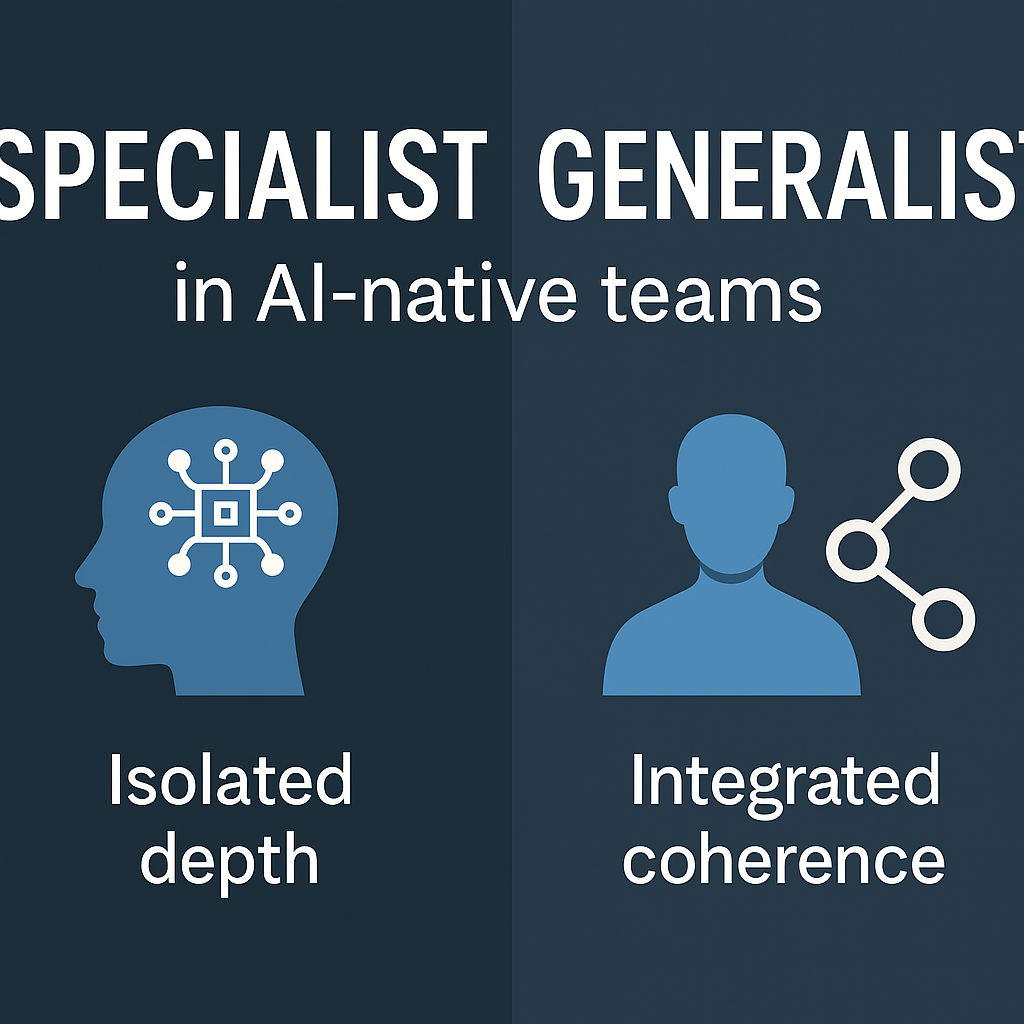
The edge now belongs to generalist and more specifically to those who can synthesize
There’s a shift underway.
For years, the message was clear: specialize.
Narrow your focus. Go deep. Be the expert.
AI just made depth a commodity. And suddenly, the people who can connect the freaking dots are the ones holding all the cards.
Now we’re entering a new phase one where synthesis outpaces specialization, and context-switching becomes a competitive advantage.
Why?
Because when AI handles depth at scale, the people who can move across disciplines, connect the dots, and reframe in real time become the most valuable players on the field.
- The SQL Ninja? AI writes it faster.
- The Design Guru? AI spits out endless variations.
- The Code Whisperer? AI suggests patterns you haven't even dreamed of.
Here's the truth bomb - Specialization made sense in a slow, segmented world
In traditional orgs, deep specialists kept systems stable:
- The finance lead who knew the codebook
- The designer who mastered a specific brand
- The engineer who owned a tiny slice of backend logic
But AI just blew up those kingdoms.
But now AI can write SQL, test design variations, suggest code patterns, even summarize tax positions.
It’s not perfect—but it’s getting faster and broader every day.
The result?
Depth isn’t disappearing it’s becoming instantly accessible.
Which means the real constraint is no longer what you know,
but how well you navigate across what the system already knows.
What generalists do differently
Generalists aren’t just “not specialized.”
They bring three superpowers to AI-native teams:
- Interface Detectors: They see the cracks. Where product and sales are speaking different languages. Where design is ignoring ops. They build bridges, not walls.
- Layer Hoppers: They switch from user-speak to workflow diagrams to market strategy in seconds. They live in the zoom-in/zoom-out world that AI can't touch.
- System Architects: They see the patterns others miss. They don't just fix the bug; they rewrite the code of the system.
This is the new power layer
Generalists used to be seen as “floaters” or “utility players.”
Now they’re quietly running the show:
- Product leads who can design, write, and think commercially
- Ops leaders who understand incentives, systems, and communication
- Strategy heads who can synthesize across org, tech, and customer
In AI-shaped teams, the ability to direct, interpret, and realign across domains becomes the multiplier.
The new generalist isn’t a jack-of-all-trades. They’re an architect of coherence.
They make the system legible.
They reduce complexity across surfaces.
They don’t just touch multiple functions they bring unification logic.
Their work doesn’t always show up in dashboards.
But the whole system works better because they’re in it.
What to do now
- Redraw your team’s value map
Don’t just measure depth. Start surfacing synthesis as a track. Who’s holding cross-functional tension? Who’s fixing the un-owned friction? - Identify the “bridgers” on your team
They’re probably not loud. But they’re the ones who are trusted across departments. Give them elevation. - Stop treating generalism as lack of clarity
It’s a function. Treat it like one. Fund it like one. Promote from it. - Design roles around interfaces, not just functions
The org chart of the future won’t be built around departments. It’ll be built around flows—and the generalist is the flow designer.
The Work That Remains? isn’t about doing more.
It’s about holding the parts together.
And the generalist is no longer optional.
They’re the glue, the integrator, the navigator.
Not because they know everything—
but because they know how to make sense of everything that changed.
What if 'strategic advantage' isn't about perfectly predicting market trends, but about thriving in the unpredictable? What if the true generalist CEO, or strategist, or leader, isn't just connecting market data points, but learning to navigate the white space where those points become irrelevant, where innovation emerges from the chaos itself? Are you ready to build a company that dances with disruption? Or are you still trying to build a fortress against it?
More soon,
Gage Batten
Under Construction
How work is being rebuilt in real time