When AI Breaks in Construction—And What That Teaches Us

Construction is one of the hardest stress tests for AI
Why?
Because it’s a domain full of:
- Incomplete data
- Conflicting inputs
- Unpredictable environments
- Human-first judgment calls
- Legacy platforms duct-taped to newer ones
It’s not clean, tagged, or ready.
It’s built on job-to-job variance, field adjustments, and the knowledge that things rarely go as planned.
Which makes it a brutal environment for any AI system expecting structure, consistency, or clarity.
But also—exactly the environment where AI should prove itself.
Real examples of where it breaks
Submittal log cleanup
You feed AI a stack of submittals, specs, and emails.
It’s supposed to organize them. But it can’t tell that “Rev 2” is more current than “Final for Review.”
Now you’re fixing misfiled documents by hand.
Daily logs
You ask AI to summarize dailies across multiple crews.
It doesn’t understand that “no issues” means “framer didn’t show up” and “weather delay” means “we lost $15K in productivity.”
The summary looks fine. The reality is chaos.
Inventory prediction
An AI tool tells you your material buffer is sufficient.
It’s wrong.
It didn’t account for lead times slipping or crews changing sequence.
Now you’re delayed and explaining it to the GC.
RFI summarization
You run RFIs through a summarizer to simplify reporting.
It merges two RFIs with similar language—but different scopes.
And now a detail gets built wrong because the nuance was lost in translation.
These aren’t AI problems—they’re system exposure moments
The model didn’t fail.
Your process failed the model.
That’s the uncomfortable truth.
AI breaks in construction because:
- The data was never centralized
- The workflow was never formalized
- The definitions weren’t agreed on
- The process was held together by “we all just know”
And when you bring AI into that environment, it becomes the first thing that can’t play along.
So it breaks.
And in doing so, it shows you where your real friction lives.
What these failures actually teach us
- You can’t automate what you haven’t mapped
If no one on your team could draw the process on a whiteboard, the AI won’t figure it out either. - You’re relying on human memory more than you think
The amount of institutional knowledge in field superintendents’ heads is astonishing. AI exposes how little of it is written down, tagged, or structured. - Edge cases aren’t edge cases—they’re everywhere
Construction is full of “exceptions.” AI sees these as system-breaking bugs. Humans see them as “Thursday.” - Your platforms don’t talk to each other
Scheduling lives in P6. Field reports in Procore. Material tracking in spreadsheets. AI doesn’t know how to route across that unless you explicitly design for it.
So what’s the move?
Don’t ditch the AI.
Use it like a probe.
Every time it fails, it’s telling you something your current system was hiding.
Something that would’ve caused a delay or issue anyway—but went unseen because it was handled manually, reactively, or just barely.
Better AI starts with better architecture
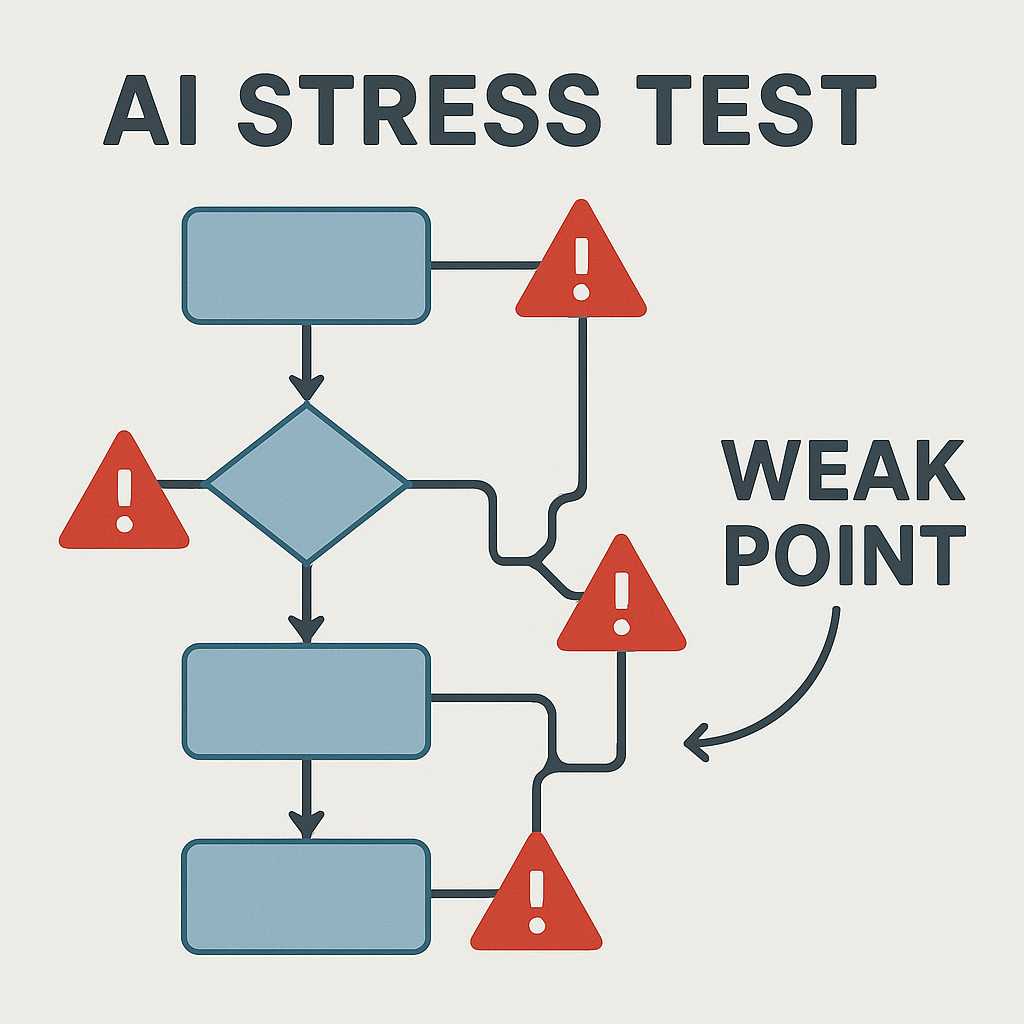
AI doesn't break workflows.
It spotlights their weak points.
And if you’re willing to lean into that discomfort, it becomes a diagnostic tool.
A forcing function.
Because once you can’t pretend the process works anymore, you can finally fix it.
If you’ve tried AI in the field or back office and it fell short, don’t chalk it up as failure.
Start digging into why it failed—and what it revealed.
That’s where the real ops work lives.
More soon,
Gage Batten
Under Construction
How work is being rebuilt in real time