Why "Good Enough" AI Is More Dangerous Than Broken AI

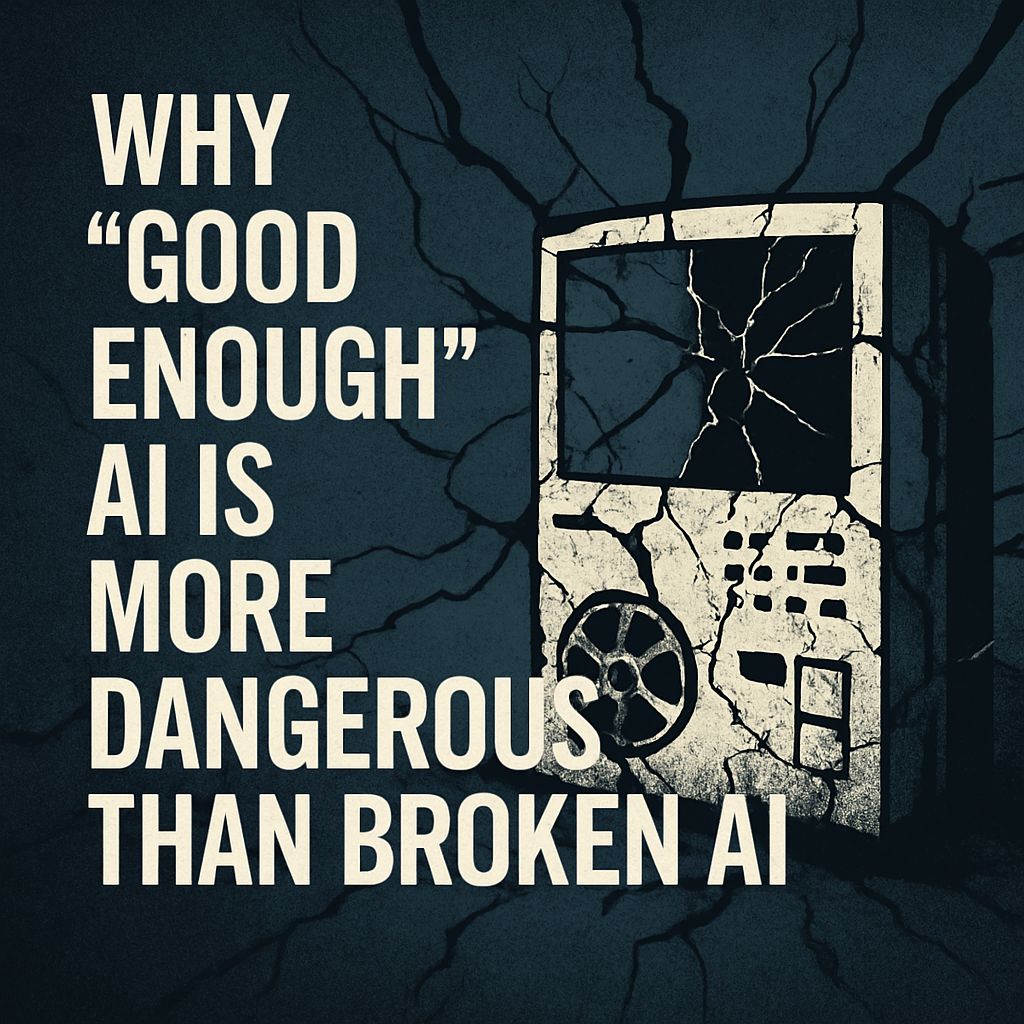
The invisible risks of systems that almost work.
There’s a kind of AI no one’s scared of until it’s too late.
It doesn’t crash.
It doesn’t hallucinate wild nonsense.
It doesn’t wave red flags.
It works.
It completes the task.
Sounds confident.
Looks polished.
Feels smart.
It’s just good enough to earn your trust
but not precise enough to deserve it.
This is the AI that slips through QA.
The one that lands in production.
The one that drives real decisions in real businesses.
And when it fails, it won’t fail loudly.
It will fail quietly.
Which means you won’t catch it.
You’ll act on it.
And by the time you realize the mistake, you’ll have scaled it.
Broken AI Is Easy to Catch. “Good Enough” AI Is Easy to Believe.
The danger of broken AI is obvious.
It spits out garbage. You fix it. Or kill it.
But “good enough” AI? That’s the one that survives.
It:
- Misclassifies the wrong risk 3% of the time
- Subtly rewrites your assumptions without you noticing
- Approves the wrong vendor in edge cases
- Misses nuance but makes up for it with smooth charts
- Validates your flawed strategy with eloquence
It’s accurate enough to pass.
But not sharp enough to protect.
And when that line blurs?
We stop questioning the output.
We just move forward.
Almost Right Is More Dangerous Than Obviously Wrong
A pilot trusts the panel, not the signal.
A doctor trusts the screen, not the patient.
A team trusts the model, not their gut.
Not because they’re lazy.
Because the result looks right.
That’s what “good enough” AI does:
It wraps unverified outcomes in confidence.
And the human brain—wired for shortcuts—says: good enough.
That’s how subtle errors scale.
That’s how bad decisions start to look like strategy.
Where We’re Headed—And Why You Should Be Nervous
AI is now embedded in everything:
- Docs
- Pitches
- Reports
- Roadmaps
- Financials
- Forecasts
And the speed is seductive.
You move faster. Present cleaner. Ship quicker.
But speed conceals decay.
And quality dies the moment no one double-checks.
The risk isn’t one big miss.
It’s the cumulative erosion of integrity across 1,000 micro-decisions.
By the time you realize the foundation’s weak,
you’re standing on it.
Good Enough AI + Human Overconfidence = Fragility at Scale
We’re pairing:
- Instant answers
- Beautiful formatting
- And a growing human tendency to skip checking what “feels close enough”
This is how:
- Forecasts drift from reality
- Strategy compounds on false precision
- Brand trust erodes without a single headline
No one raises their hand because the AI sounds fine.
And you don’t see the failure in the report.
You see it in the results weeks later.
By then, the damage is operational.
Not technical.
What Do We Do Now?
If “good enough” is the new default, then leadership now means refusing to accept it.
Here’s how you hold the line:
- Rebuild the habit of verification.
If it came from AI, it doesn’t count until a human checks it. - Audit what you’ve automated.
Every AI-powered workflow should be stress-tested like a bridge—not trusted because it hasn’t collapsed yet. - Raise—not lower—your definition of accuracy.
Don’t let speed become a substitute for truth. - Reinforce the role of judgment.
AI doesn’t replace decisions. It supports them. The final call still needs a brain attached to a spine. - Train your teams to challenge polished output.
Beautiful is not the same as correct. Easy is not the same as done.
Because what’s coming isn’t worse AI.
It’s more invisible AI working behind the curtain of every doc, insight, and plan.
If you don’t design your systems for scrutiny, they’ll quietly optimize for confidence over correctness.
And you won’t know you’re off-course until you’ve scaled the wrong thing perfectly.
One Final Thought
We talk about AI like it’s either broken or brilliant.
But the real danger sits in the middle.
The system that mostly works.
The model that almost knows.
The tool that saves you time but slowly erodes your standards in the background.
That’s the future that’s most likely.
Not a machine that replaces you But a machine that reshapes you.
Not by force.
But by drift.
A thousand subtle nudges.
A thousand clean answers.
A thousand missed chances to say,
“Is that actually right?”
We won’t be outcompeted by AI.
We’ll be out-decided by people who kept their edge while we outsourced ours.
And by the time we look up?
It won’t be that we lost control.
It’ll be that we forgot we ever had it.
That’s what’s under construction now.
More soon,
Gage Batten
Under Construction
How work is being rebuilt in real time